

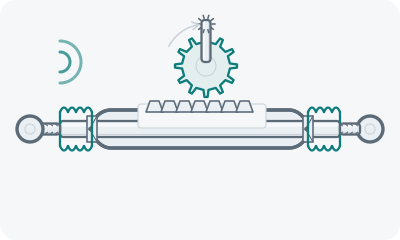
A knock that comes straight into the wheel over small bumps is a complaint that almost always produces two words at a workshop: the rack and the ends. The steering rack turns rotation of the wheel into lateral movement of the tie rods. The track rod ends are the ball joints at the ends of those rods, connecting them to the steering knuckles. Both wear with mileage, both knock over bumps, and their cost is entirely different: the gap between replacing an end and rebuilding a rack is tenfold. So the versions are worth separating before, not after, the work order is signed.
How each sounds
The rack knocks from the centre, dully and “from inside”. Its characteristic marker is that the knock appears on fine undulating roads with the wheel almost straight, travels into the steering column and is felt through your palms as light impacts. Another sign: the knock is heard with the car parked when the wheel is jerked left and right through a small angle.
A track rod end knocks more sharply and closer to the wheel. Its typical scenario is single clicks over expansion joints and as the steering changes direction, localised on one side. A worn end is almost always accompanied by the car pulling and uneven tyre wear at the tread edge.
| Sign | Steering rack | Track rod end |
|---|---|---|
| Location | From the centre, under the dash | From one side, at the wheel |
| Timbre | Dull, internal | A dry click or knock |
| With the car parked | Knocks when the wheel is rocked | Usually silent |
| Steering play | Free movement present | Appears at a late stage |
| Tyre wear | No direct link | Often uneven at the edge |
| Check | Rock the wheel with a helper | Rock the wheel horizontally |
The checks you can do yourself
The first needs a helper. The car is parked, engine off, the wheel is rocked left and right within its free play while you keep a hand on the tie rod at the rack bellows. A knock felt through your palm as an impact from inside the housing points at the rack — signs of a faulty steering rack.
The second is at the wheel. A raised wheel is taken at 9 and 3 o’clock and rocked horizontally. Play in that plane points at the steering parts: the end, the rod or the rack itself, covered in signs of worn track rod ends and signs of worn tie rods. Play in the vertical plane, at 12 and 6, takes the diagnosis towards the hub or the ball joint. Separating by component rather than by loudness is the general principle; it applies in a knock when braking: pads or caliper too.
The third is by traces. A torn rack bellows, power steering fluid stains, a split boot on an end — all of that is visible and speeds up the conversation. The general catalogue of suspension and steering knocks is on the symptom page knocking in the suspension.
What is often mistaken for the steering
Parts working next to the rack and rods knock very similarly but cost less to fix. The anti-roll bar links are the first candidate: their sound also arrives on small bumps and also reaches the front of the car, but it is the same whatever the steering is doing — signs of worn anti-roll bar links. A strut top mount bearing crunches and clicks specifically when the wheel turns, including on the spot, and is silent in a straight line — signs of worn strut top mount bearings. A worn control arm bush knocks dully and is more noticeable when pulling away and braking. Before agreeing to rack work, ask for that trio to be ruled out — it is cheaper and more common.
How the repair is decided
An alignment after any work on the tie rods is compulsory and often forgotten in the budget: without it the geometry is off and the tyres wear quickly.
One more observation from practice: a rack knock often turns out to be a companion rather than the only fault. If the lift reveals both play in an end and free movement in the rack, it is wiser to replace the ends first and reassess the sound — some knocks simply disappear after that, and the expensive rack job is postponed indefinitely. Ask the mechanic to show you the play on each part rather than describe it.
Steering knocks record well if you know where to look. Drive over a fine undulating surface and record the sound in the Pro-Stuk app, then make a second recording in a car park while rocking the wheel. The app compares them and shows the likely causes with percentages — and suggests which plane of play to start checking.
