

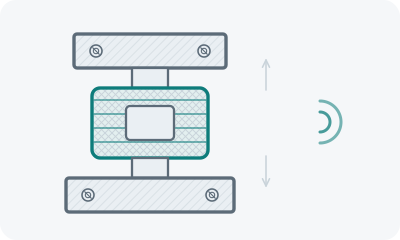
The top mount bearing is a small assembly at the top of a front strut, between the spring and the body. It lets the whole strut rotate with the wheel as you steer, while carrying the car’s weight into the body through a rubber mount. While it is healthy nobody remembers it exists; worn, it spoils both the sound and the steering. The catch is that its symptoms are routinely blamed on struts, ball joints or the steering rack. Here are the signs that identify it almost without fail.
The characteristic sounds of wear
- Crunching or clicking as you turn the wheel parked. The most recognisable sign: turning the wheel with the car stationary produces a dry crunch, creak or individual clicks from above, from the strut tower area. The related symptoms are on clicking when steering, and the detailed breakdown in a noisy strut top mount bearing: symptoms.
- A dull knock from above over small bumps. A worn mount passes impacts from the strut straight into the body — heard above the wheel, almost from under the windscreen, and felt in the floor.
- Creaking when the car is rocked. Push down on a wing and a worn mount creaks or clicks.
- A knock coming off a kerb or in a pothole. A single hard thump from above as the loose mount shifts under load.
Sound is not the only signal. A worn top mount bearing changes the steering too:
- the wheel turns with effort or in steps, as though binding;
- it returns to centre less readily after a turn;
- vibration and kickback from small bumps are felt through the wheel;
- the car wanders slightly and needs constant small corrections.
These symptoms overlap with worn dampers, so it makes sense to diagnose them together — what to check on the struts themselves is in how to tell shock absorbers are dead.
Telling it from similar faults
| Sign | Top mount bearing | Damper | Anti-roll bar links | Ball joint |
|---|---|---|---|---|
| Crunch steering while parked | Yes, from above | No | No | Rarely, from below |
| Knock over small bumps | Dull, from above | Possible | Frequent, sharp, from the side | Metallic, from below |
| Heavy or notchy steering | Yes | No | No | No |
| Body float | No | Yes | No | No |
| Knock in turns | Possible | Rarely | Yes | Possible |
Sharp frequent knocking over washboard surfaces is more often the signature of the anti-roll bar links, covered in what happens if you do not replace anti-roll bar links. The general picture of knocking at the front is on knocking over bumps.
How to check it yourself
- A hand on the spring. Open the bonnet, put a palm on the strut tower and have a helper turn the wheel with the car parked. A healthy mount works silently and without kickback; crunching and jolts into your palm mean wear.
- Rocking. Push down on the wing over the wheel: creaks and clicks from above point at the mount, and if the body bounces more than once after you release it, the damper is in question too — the method is in checking shock absorbers with the bounce test.
- Inspection from above. On many cars the mount is visible in the engine bay: cracked rubber, a tilted mount, traces of rusty water around the tower are indirect signs.
- A check on a lift. The mechanic checks strut play by the spring with the wheel raised and inspects the mount from below. That takes a few minutes and is usually free when you book a repair.
Service life and causes of wear
Typical life is roughly 80,000–120,000 km, but the spread is wide. The part sits at the very top of the suspension and collects all the water, dirt and winter chemicals running down the tower. Its sealing is modest, so corroded tracks and a broken plastic cage kill the part rather than mechanical wear as such.
Three things speed it up. Broken roads: every impact the damper fails to absorb reaches the mount. Tired dampers: the worse they work, the more impacts the top mount takes, which is why worn struts and worn mounts are so often found together. And the habit of turning the wheel with the car standing still: under full load without rolling, the bearing works in its hardest regime. It cannot be avoided entirely, but steering with even minimal movement noticeably extends its life.
How the repair is decided
Replacing a top mount bearing requires the strut to come off and be stripped with spring compressors, so the labour costs almost as much as replacing a damper. That single fact drives every sensible decision here.
If dampers or springs are being replaced at the same time, the extra for the bearings comes down to the price of the parts — stripping the strut is already in the job. That is exactly why workshops recommend doing them in one visit, and why doing them separately is the classic regret.
Two things to ask about. First, whether the alignment will be checked afterwards: stripping a strut disturbs the camber on many cars. Second, whether the mount is supplied as a bearing alone or a complete mount assembly — on many designs the rubber is at the end of its life by the time the bearing is, and fitting a new bearing into old rubber brings the noise back.
What ignoring it leads to
There is no catastrophic scenario here as there is with a ball joint — the wheel will not come off. But a worn mount does steady damage: impacts go into the body and wear the seat in the strut tower, the steering becomes vague and heavy, and the top of the damper wears faster. In advanced cases the bearing binds and the strut turns in jerks, so the wheel has to be forced round. The repair only gets dearer, so there is no sense in stretching it beyond a few weeks.
If something is crunching or knocking above and the culprit is not obvious, record the sound in the Pro-Stuk app. It matches the recording with your answers and shows the likely causes with an urgency level, so the workshop can check specific parts rather than everything at once.
