

A knock or crunch when turning the wheel with the car parked is a common complaint, and more informative than it seems. Steering on the spot is the hardest regime for the whole steering chain: the wheels turn without rolling, the tyres resist with their entire contact patch, and the forces on the joints and bearings are at their peak. That is exactly why play that stays silent on the move is taken up with a knock while parked. Here are the components that produce it, how to tell them apart, and what the repair involves.
Why the sound appears specifically while parked
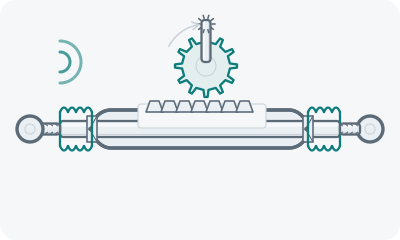
Steering on the spot sends effort along a long chain: the wheel, the steering shaft, the rack, the tie rods and track rod ends, the steering knuckle rotating on the ball joint below and the strut top mount bearing above. Any play in that chain shifts under maximum load — hence single knocks as the steering changes direction. Components with broken raceways — above all the top mount bearings — give not a knock but a crunch and clicking throughout the turn. The related symptoms are on clicking when steering.
An aside: since steering on the spot is the hardest regime, the habit of turning the wheel with the car stationary shortens the life of the top mount bearings and the power steering. Turning the wheel with even minimal rolling is cheap prevention.
The main suspects
- The strut top mount bearing. Top of the statistics. The unit at the top of the strut through which it rotates as the wheels turn. A worn one crunches and clicks from above, at the strut tower. The detail is in signs of worn strut top mount bearings.
- Track rod ends and tie rods. The joints at the ends of the tie rods. Play gives a short dry knock as the steering changes direction, from below on the wheel side. The full picture is in signs of worn track rod ends.
- The steering rack. Wear in the rack and pinion or in the bushes gives a dull knock centrally, at the bulkhead, often with kickback into the wheel — signs of a faulty steering rack.
- The ball joint. A dried or hammered joint creaks and knocks from below while steering; usually a knock over bumps joins it — signs of a worn ball joint.
- The steering shaft universal joint. The joint in the column between the wheel and the rack: play is heard and felt right at the wheel as a small click at the start of every movement.
- The power steering. Hydraulic systems hum more often than they knock, but with a failing pump or a low fluid level jerks and foreign sounds join the hum, as covered in power steering whine when turning.
The CV joint is not on the list, and that is deliberate: its crunch appears on the move under load at full lock, and while steering parked it is almost always silent.
Telling them apart by sound
| Sound and place | Likely source | Extra sign |
|---|---|---|
| Crunch, clicks from above at the strut tower | Top mount bearing | The crunch is felt with a palm on the spring seat |
| Dry knock from below at the wheel | Track rod end, tie rod | Knock as the direction changes, play when rocked |
| Dull knock centrally, at the bulkhead | Steering rack | Kickback into the wheel over bumps |
| Creak plus tapping from below | Ball joint | Knock over small bumps on the move |
| A click right in the wheel | Steering shaft joint | Felt in your hands at the start of each turn |
| Hum, whine, jerks in the wheel | Power steering pump | The sound follows engine revs |
Narrowing it down yourself
You need a helper and five minutes:
- A hand on the strut tower. Open the bonnet and put a palm on the top mount. The helper turns the wheel left and right while parked. Crunching and jolts into your hand mean the top mount bearing.
- A hand on the track rod end. Take hold of the end behind the wheel (steering turned for access) while the helper rocks the wheel in short movements. Jolts with a click mean play in the end or the rod.
- The engine-off test. Turn the wheel with the engine stopped. If the sound remains, the power steering is not involved and it is mechanical. If it appears only with the engine running and follows the revs, the pump or its belt are likely.
- Listen to the wheel itself. Clicks felt in your hands on the rim are the signature of the steering shaft joint or the column mountings.
- Look underneath. With a torch through the wheel arch at full lock, the track rod end and ball joint boots are visible: split rubber and grease traces narrow the search as well as any sound test.
These tests do not replace a lift, but they usually cut the list to one or two components before the workshop visit.
How the repair is decided
The good news: most causes of a knock while parked are inexpensive to fix, and a genuinely costly rack is rarer than it is suspected. Which is why the order matters — confirm the diagnosis before agreeing to rack work, not the other way round.
Two things worth insisting on. That an alignment follows any work on the track rod ends or the rack — it is part of the job, not an extra. And that replacement parts come from known manufacturers of steering and chassis components: the price difference from unbranded parts is small and the difference in service life is several-fold.
What delay leads to
There is no direct danger from most of these faults, but the decline is progressive. Play in the track rod ends drifts the wheel angles — the car starts wandering and eating tyres. A hammered top mount passes impacts into the body and damages its seat in the tower. Play in the rack eventually needs parts rather than an adjustment. So a knock while steering parked is a reason for a calm but not postponed diagnosis.
If you are unsure what exactly is making the sound, record the crunch or knock while turning the wheel in the Pro-Stuk app. It matches the recording with your answers about when the sound appears and shows the likely causes with an urgency level.
