

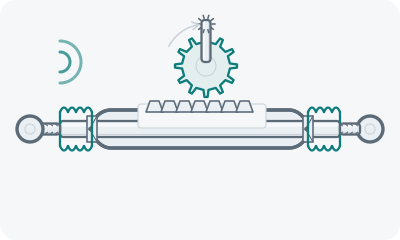
A track rod end is a small joint at the end of the tie rod, connecting it to the steering knuckle. It is through the track rod ends that effort from the steering wheel reaches the wheels, so their condition directly governs steering precision. The design is a miniature ball joint: a pin with a ball in a lined socket with grease, closed by a rubber boot. It wears gradually and warns you in advance — with sound, steering play and the way the car behaves in a straight line. Track rod ends work together with the tie rods, the joints at the inner ends by the rack; their symptoms overlap heavily, and the inner ones have their own breakdown in signs of worn tie rods.
How the wear shows itself
- A dry knock over small bumps. A short, abrupt sound from below, on one front wheel’s side, over expansion joints, washboard surfaces and small potholes. The general description is on knocking over bumps.
- A knock when steering while parked. The loose joint shifts as the steering changes direction — a single “tock”.
- Steering play. The free movement at the rim has grown noticeably: the wheel can be rocked several centimetres before the wheels respond.
- Wandering in a straight line. The car follows ruts, needs constant corrections, and the steering feels empty around centre.
- Steering wheel vibration. On rough tarmac the rim shakes finely — the play lets impacts from the wheels into the steering. The related symptom is clicking when steering.
- Uneven tyre wear. Toe that has drifted because of the play eats the inner or outer edge of the tyre.
No single sign is a verdict on its own: ball joints, bushes and the steering rack give a similar picture. But the combination of “a knock when using the steering plus increased play at the rim” points at the steering system with reasonable confidence.
The stages of wear
| Stage | Signs | What to do |
|---|---|---|
| Early | Occasional knock on washboard, no steering play | Inspect the boots, watch |
| Middle | Regular knock, slight steering play | Diagnosis within 1–2 weeks |
| Late | Wandering, vibration, chewing tyres | Replace without delay |
| Critical | Large play, clattering, the car pulls | Do not use until replaced |
How fast it degrades depends on the roads and the state of the boot. A torn boot moves the part from the early stage to the late one within a few months: the grease washes out and abrasive gets in. A separate scenario is a pothole or kerb strike with the wheels turned: the energy travels along the tie rod straight into the joint, and play can appear from one event. If the steering wheel sits crooked when driving straight after such a strike, an inspection is needed immediately — the rod itself may be bent, not just the end.
How to check it yourself
The basic check takes ten minutes and needs no lift:
- Rocking the wheel with a helper. Engine running, the helper rocks the steering left and right in short movements of 5–10 centimetres. You keep a palm on the track rod end behind the front wheel, with the steering turned for access. A healthy joint transmits the effort as one piece; jolts with a click into your palm mean play. The full procedure is in checking track rod ends for play.
- Rocking the wheel at 9 and 3. With the wheel jacked up, take it horizontally (at the 9 and 3 o’clock positions) and rock it. Horizontal play with a knock points at a track rod end or the tie rod — unlike vertical play at 12 and 6, which comes from the ball joint or the wheel bearing.
- Inspecting the boot. Turn the steering and look at the joint through the arch: cracks, tears in the rubber, grease traces and rusty dust around the joint mean it is on borrowed time, even without a knock.
Every jack test is done on level ground with chocks and a safety stand: never get under a car held only by a jack. If something knocks and the culprit is not obvious, the step-by-step search plan is in finding a suspension knock without a lift.
What it gets confused with
The closest lookalike is the ball joint: the same joint design, the same dry knock from below. The difference is in what triggers it — a track rod end speaks up when the steering is used, a ball joint over bumps regardless of the steering; the checks are in how to check a ball joint yourself. The second lookalike is control arm bushes, whose knock is duller and more “rubbery”, covered in signs of worn suspension bushes. Finally, play and a knock felt centrally, straight through the steering wheel, is characteristic of the steering rack — a dearer repair, so it is worth ruling out the cheap joints first. Another neighbour is the wheel bearing: it also gives wheel play, but vertically and with a hum at speed, and its play disappears with the brake pressed.
How the repair is decided
Replacing track rod ends is one of the cheapest running gear jobs, and the alignment afterwards is not optional — it is part of the job, not an upsell. Budget for it from the start.
Two things worth asking. Whether the old end came off the rod or the thread was seized: a seized end sometimes takes the rod with it, which changes the parts list mid-job. And whether the rod itself was checked for straightness if the car has hit anything — a bent rod fitted with a fresh end will never align properly.
On parts, stick to known manufacturers of steering components: saving on an unbranded joint is usually swallowed by repeating the labour and the alignment.
What ignoring it leads to
A track rod end rarely fails instantly, but the final stage is unpleasant: with total wear the pin can come out of the housing and the wheel stops obeying the steering. That is usually a long way off — much sooner the car starts eating tyres, wandering and tiring you with constant corrections. There is an economic argument too: driving with play wears the mating surfaces and the neighbouring parts, turning a cheap repair into an expensive one.
If something knocks below and you are not sure of the diagnosis, record the sound in the Pro-Stuk app. It matches the recording with your answers about when the knock appears — over bumps, when steering, when braking — and shows the likely causes with an urgency level.
