

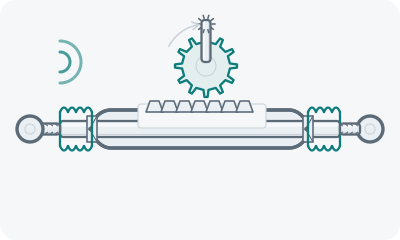
A track rod end is the joint at the end of the tie rod through which force from the rack reaches the hub carrier. It wears predictably: the ball pin beats out its seat, play appears, and with it come knocking over bumps, imprecise steering and uneven tyre wear. Checking it yourself is not hard, provided you know what to hold and where to put your hand — that is what separates a useful check from a pointless one.
What you are looking for
Inside the joint there is a ball pin in a polymer or metal seat, sealed by a rubber boot. While the boot is intact the joint lasts a long time: grease inside, dirt outside. As soon as the boot tears, sand and water get in, the seat wears and the pin starts moving in its housing. So the first thing to do is simply to inspect the boots: cracks and squeezed-out grease often make the diagnosis before any test.
The second sign, available without tools, is how the steering behaves. Growing free play, a vague feel around the straight-ahead, knocks felt through the wheel over small bumps and the car wandering after braking add up to the typical picture of a worn steering linkage.
Checking with the wheel raised
Follow the safe raising procedure in full — chocks, a support under the sill, handbrake applied. Then the technique is this:
- Take the wheel at 3 and 9 o’clock (the sides) and rock it in the horizontal plane with short, sharp movements.
- Play and knocking in this grip point at the steering linkage: the track rod end, the tie rod or the rack itself.
- Without changing the movement, place a palm on the track rod end joint. A knock felt through your fingers condemns it.
- Move your hand to the inner joint of the tie rod and repeat. That separates the outer element from the inner one.
- As a control, rock the wheel at 12 and 6 o’clock: play in that grip belongs to the wheel bearing or the ball joint instead.
A helper speeds things up noticeably: while they rock the steering wheel through a small angle, you hold your hand on each joint in turn.
Separating the sources
| Where the knock is felt | Part | What next |
|---|---|---|
| In the track rod end joint | Track rod end | Replace, then align |
| In the joint by the rack | Inner tie rod | Replace the rod |
| In the rack housing, by the boot | Steering rack | Adjustment or repair |
| In the ball joint below | Ball joint | Replace |
| In the anti-roll bar link | Anti-roll bar link | Replace, a small job |
The anti-roll bar link is worth checking first: it produces a similar sharp knock over small bumps and costs a fraction of any steering component. The general picture of knocks at the front is on the symptom page knocking in the suspension.
How the repair is decided
Two practical points shape the job. A seized track rod end sometimes cannot be removed without damaging the tie rod, and a workshop should warn you about that possibility in advance rather than after the fact. And replacing track rod ends in pairs usually makes sense: they wear at the same rate, and doing one means a second visit and a second alignment a month later.
Wheel alignment afterwards is part of the job, not an extra — and it is worth asking for the printout, because that is what shows the toe was actually set rather than eyeballed.
The same “check it yourself in ten minutes” logic works for other parts: driveshafts are checked by driving slow circles in a car park, and the timing drive is judged by ear at a cold start — see checking timing chain tension by ear.
If you can hear the knock but cannot catch it by hand — normal at the early stages of wear — record the sound in the Pro-Stuk app while driving over small bumps. The app matches the recording with your answers and shows the likely causes with percentages, so the lift check targets a specific theory rather than the whole front suspension.
