

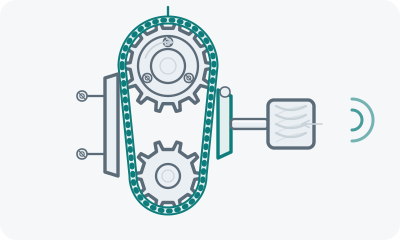
The timing chain is the drive that keeps the crankshaft and camshafts in step. Unlike a belt it has no strict replacement interval and lasts “as long as it lasts”, wearing gradually: the link pins wear, the chain grows longer, and the tensioner has more and more trouble holding it. The only early sign available to an owner without dismantling anything is the sound. Here is where to listen and how not to confuse a chain with other sources of noise.
Three conditions where the chain gives itself away
Cold start. The most informative check. Start the engine after a night’s stand while you stand next to the open bonnet. A stretched chain gives a short, coarse rattle or rustle in the first 1–3 seconds, before the tensioner builds oil pressure. The longer that sound lasts, the more serious the wear: five seconds or more is already worrying.
Lifting off. On a warm engine, raise the revs to 2,500–3,000 and release the pedal sharply. As you lift off, chain tension drops, and a worn chain slaps briefly against the guide. A healthy drive is silent on lift-off.
Idle after warm-up. Listen to the engine from the timing drive end — the side of the block where the chain cover sits. An even rustling background heard specifically there, changing pitch with revs, is a bad sign. A screwdriver or a stethoscope held against the cover helps localise it.
Telling a chain from other sounds
| Sound | Character | When you hear it |
|---|---|---|
| Stretched chain | Rustle, metal chattering against plastic | Startup, lift-off, at the timing cover |
| Hydraulic lifters | Rapid, even ticking | First minutes after starting, from the top |
| Injectors | Dry clicking in time with revs | Constantly, evenly, never building |
| Accessory idler | Hum or howl | Constantly, follows revs |
| Exhaust manifold | Sharp metallic puffing | Under load, from below at the front |
The main divider is place and condition. A chain sounds from one end of the engine and is loudest at the moments when oil pressure or load changes. Valve train ticking comes from under the valve cover and usually fades as the engine warms — see how to check hydraulic lifters. The general catalogue of this family of sounds is on the symptom page engine knock when cold.
What confirms the diagnosis besides hearing
Hearing gives you a suspicion, not proof. The indirect confirmations worth checking before any repair:
- camshaft correlation fault codes stored in the control unit — visible on a scan;
- a wandering idle and a lazy response to the throttle;
- unstable starting, especially when hot;
- the level and condition of the oil: a low level and thickened oil produce chain noise by themselves, and sometimes an oil change is enough to silence a “stretched chain”.
At a workshop the chain is assessed by how far the tensioner plunger has extended and by the wear mark on the guide, and on some engines by the camshaft correlation angle on a scan tool. Those are objective numbers, and they are worth asking for before agreeing to dismantling.
How the repair is decided
The order of steps runs from cheap to expensive: the oil and its level first, then the scan, and only then dismantling.
If the chain is confirmed, it is replaced as a kit — chain, tensioner, guides and usually the sprockets. Fitting a new chain onto worn sprockets and old guides brings the noise back within tens of thousands of kilometres, which is why a workshop quoting for the chain alone is worth questioning. On engines where the water pump sits behind the same cover, it belongs in the same job for the same reason: the access is already paid for.
If the rattle is already audible on a warm engine, do not postpone — a chain that jumps on most modern engines ends with the pistons meeting the valves.
Recording a cold start is easiest in the Pro-Stuk app: start the recording before you turn the key and hold the phone near the radiator grille. The app compares the sound with your answers about duration and conditions and shows the likely causes with percentages — and the recording stays, to be played to the mechanic.
