

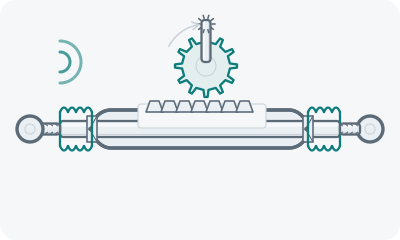
A tie rod is the bar connecting the steering rack to the track rod end and passing effort from the steering wheel to the wheel. At its inner end sits an axial joint, screwed straight into the rack and hidden under a pleated bellows. The part works in constant motion and, together with the track rod ends, is the first to take impacts from the wheels, so on broken roads it wears before most of the running gear. Here are the signs of wear in increasing order, the checks you can do without a workshop, and what decides the repair.
Signs by stage of wear
| Stage | What you hear and feel | What to do |
|---|---|---|
| Early | Occasional soft knock over small bumps | Watch, check at the next service |
| Middle | Constant chatter on washboard surfaces, slight steering play | Diagnosis within a couple of weeks |
| Late | A knock over any bump, pulling, wandering in a straight line | Replace without delay |
| Critical | Large steering play, the car floats in its lane | Stop driving it |
The first alarm is almost always audible: a fine chatter on rough tarmac felt through the steering wheel. Over time free play at the rim joins it, and you find yourself correcting even in a straight line. Similar sounds come from other parts, so the general breakdown is on the symptom page knocking over bumps.
Indirect signs that are easy to miss
- The car pulls to one side. A worn joint changes the steering geometry and the car stops holding a straight line.
- Uneven tyre wear. An eaten inner or outer tread edge on one side is a common result of play in a rod.
- An imprecise centre. After a turn the wheel does not return to the same place and straight-line running has to be hunted for.
- Wandering under braking. With play present, the wheel has freedom and changes direction slightly as the car dives.
Each of these has other explanations too — from tyre pressure to alignment. But combined with a knock they add up to the characteristic picture of worn steering joints.
How to check tie rods yourself
The most informative test needs a helper and five minutes. The car is on the ground with the engine running. The helper rocks the steering left and right through 10–15 degrees in short movements while you place a palm on the rack bellows where the rod enters the housing. Thumps and clicks under your palm mean play in the inner joint. Then move your hand to the track rod end: that separates the two parts, which are often confused — their own breakdown is in signs of worn track rod ends.
The second test is with the wheel raised. Take the wheel at the 9 and 3 o’clock positions and rock it towards and away from you. A knock with noticeable free movement points at the steering joints — the rod or the end; play at 6 and 12 is a different story, the hub or the ball joint. The detailed procedure is in checking track rod ends for play.
It is important not to confuse a rod with the rack itself: clearance in the rack mechanism also gives a knock when the steering is rocked. A rack that hums when you turn is a different fault again, covered in power steering whine when turning.
How the repair is decided
Two things are worth settling before the work starts.
First, the alignment. It is a compulsory line in the estimate, not an option: the length of the new rod sets the toe angle, and without the rack the car will pull and wear tyres.
Second, the bellows. The rack bellows has to come off to reach the inner joint, and a bellows that is already cracked should be replaced while it is off — refitting a torn one lets water into the rack and turns a cheap job into a rack rebuild later. Ask whether a new bellows and clamps are in the quote.
Replacing rods in pairs is not compulsory: if the other side has no play, one is enough. But if the car has covered more than a hundred thousand kilometres and one joint is finished, the other is usually close behind — sometimes it is more sensible to close the question in one visit and one alignment.
What driving with worn rods leads to
A worn tie rod does not create “the wheel will fall off” danger until the final stage: the joint knocks first, then develops play, and only with extreme wear can it separate — at which point the wheel stops obeying the steering. Long before that come the smaller costs: an unevenly eaten set of tyres, lost alignment, tiring corrections on the motorway. A separate risk is a torn bellows: water and dust kill even a fresh joint within a season, which is why inspecting boots is part of any running gear diagnosis.
If a knock in the steering is audible but the diagnosis is unclear, record the sound in the Pro-Stuk app on a representative stretch of road. The app matches the recording with your answers and shows the likely causes with an urgency level — so you arrive at the workshop with a ready hypothesis.
