

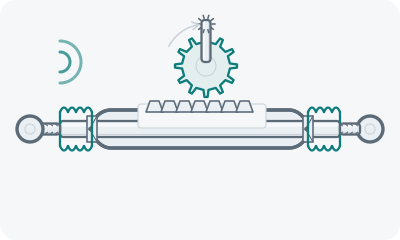
Once a workshop confirms that the knock really is the steering rack, the owner has three roads: adjust it, rebuild it, or replace the unit outright. Parts sellers predictably vote for replacement, adjusters vote for an adjustment. The truth depends not on opinions but on where exactly the clearance appeared and how evenly the rack and pinion have worn. Here are the criteria and the usual mistakes.
What an adjustment actually is
Inside the rack, a spring-loaded yoke presses the toothed bar against the pinion. With mileage the pinion-and-bar pair wears, the clearance grows, and on small bumps the bar starts hitting the pinion — that is the familiar dull knock, one of the most common on the symptom page knocking over bumps. An adjustment means turning the screw that loads the yoke: the clearance shrinks and the knock goes. Nothing inside is replaced or restored — the adjustment simply takes up the play that has developed.
Hence the main limitation: an adjustment only helps while the clearance is small and even along the whole travel of the bar. Wear always concentrates in the centre, where the steering works most. Adjust a badly worn rack “by the centre” and the pair will be pinched at the ends of the travel: the steering starts binding in bends, which is more dangerous than the original knock.
Adjust, rebuild or replace
| Situation | The sensible decision |
|---|---|
| Light knock, small play, dry bellows | Adjustment |
| Knock returned soon after an adjustment | Rebuild |
| Large play, binding at the ends of travel | Rebuild |
| Fluid leaking from the bellows (hydraulic) | Rebuild with new seals |
| Deep wear on the bar, scoring, corrosion | Replace the unit |
| Damaged housing, repair impossible | Replace the unit |
A rebuild means stripping the unit and replacing bushes, seals and the yoke from a repair kit, with the shaft reground if needed. Replacement is justified when the geometry of the bar can no longer be restored: a new or remanufactured rack goes in with a warranty.
One aside about power assistance. On hydraulic racks, before deciding, make sure the noise and heavy steering are not down to the pump: its voice is clearly heard when the wheel is turned to full lock. On racks with electric assistance built into the rack or the column, only the mechanical part can be adjusted, and the “electrical symptoms” — heavy steering, unequal effort side to side — have nothing to do with the yoke; their list is in electric power steering fault signs.
How the repair is decided
The order of thinking is straightforward: while the wear is even, an adjustment honestly postpones a rebuild by tens of thousands of kilometres. When the knock comes back quickly, every further adjustment only pinches the pair and brings replacement closer. It is cheaper to stop and rebuild.
Ask two things before agreeing to work. Whether the adjuster still has travel left — an adjuster already at its limit means the answer is a rebuild, not a tweak. And whether an alignment is included: any work involving the tie rods changes the toe, and without a fresh alignment the tyres pay for it.
How not to pay twice
Three practical rules. First: before any decision, be sure it is the rack knocking and not the rod joints, the mountings or the subframe — the dull knocks of these parts are indistinguishable by ear even to an experienced one. The way to separate them is set out in a knock: steering rack or track rod ends, and the anti-roll bar links, the cheapest of the suspects, in checking anti-roll bar links for knocking.
Second: after an adjustment check the self-centring — coming out of a bend, the wheel should want to return to centre by itself; sticky, “clinging” steering means it is over-tightened, and that needs correcting straight away. Third: during a rebuild replace the bellows and check the track rod ends — stripping the unit again for a small part is doubly annoying. And do not confuse the knock with a hum: an even hum that grows with speed is not the rack but most likely a wheel bearing, which has a completely different diagnostic and repair path — signs of a worn wheel bearing. The full symptom list for the mechanism itself is in signs of a faulty steering rack.
If the decision is still open and you want an independent second opinion, record the knock in the Pro-Stuk app on a stretch of road you know is rough. The app matches the sound with your answers, shows the likely causes and the level of urgency — and the conversation at the workshop becomes specific.
