

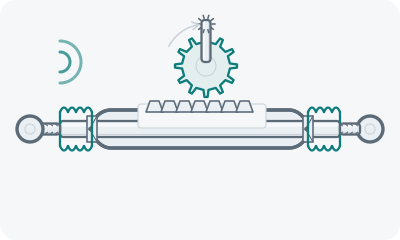
The steering rack is the central part of the steering: it turns rotation of the wheel into lateral movement of the tie rods and takes every impact from the road. A rack rarely dies suddenly — it sends clear signals for months first. Reading them is doubly useful: at an early stage the problem is solved by an inexpensive adjustment, at a late one by a rebuild or a new unit. Below is the full list of signs, simple checks and how the repair is decided.
Signs and what they mean
| Sign | Likely cause | Urgency |
|---|---|---|
| A dull knock over small bumps | Clearance in the mesh or the bushes | Diagnosis within weeks |
| Play around the straight-ahead | Wear in the rack and pinion | Diagnosis within weeks |
| Binding, the wheel turns in steps | Scoring on the bar, an over-tight yoke | Workshop within days |
| Heavy steering | Low fluid level, pump or control valve wear | Check the level at once |
| A whine when you turn the wheel | The power steering pump running on air or worn | Check the level at once |
| Oil runs on the bellows | Leaking seals on a hydraulic rack | Repair; topping up is temporary |
| The wheel does not self-centre | An over-tight yoke, a seized mechanism | Adjustment |
A knock is the most common early sign. It is dull and single, heard nearer the centre of the car and easy to reproduce while parked by rocking the steering. Other road knocks and their sources are on the symptom page knocking over bumps.
Mechanics and hydraulics: two different scripts
A rack ages along two independent paths. The mechanical one is wear in the rack and pinion, a slackened yoke and worn support bushes: it shows as knocking and play. The hydraulic one, on cars with power steering, is worn seals and control valve: fluid escapes, the steering gets heavy and the pump hums when you turn — that sound is covered on the symptom page humming when turning and in power steering whine when turning.
Knowing which path has failed matters: a knock with healthy hydraulics is often cured by an adjustment, while a leak always means a rebuild with new seals. On cars with electric power steering there is no hydraulics at all, but there is electronics with its own symptoms — signs of an electric power steering fault.
How to check the rack yourself
- The play test. With the car parked and the engine running, rock the steering with light short movements. Free movement of more than two or three centimetres at the rim, plus a dull knock, means clearance in the mechanism.
- The helper test. While a helper rocks the wheel, put a palm on the rack housing: a thump into your hand identifies the part more precisely than any listening. Knocks in the tie rod joints are felt separately — their signs are in signs of worn track rod ends and signs of worn tie rods.
- Inspect the bellows. Look underneath: the pleated boots at each end of the rack should be dry and intact. Damp, oil-filmed boots mean the hydraulics are leaking.
- Check the level. On cars with hydraulic steering, check the reservoir: a falling level with no visible puddles means a leak into the rack, with the fluid collecting in the bellows.
How the repair is decided
There are three routes — adjustment, rebuild, replacement — and the choice is not made by price alone.
An adjustment tightens the yoke that presses the rack bar against the pinion. It removes a knock when the wear is even and moderate. Its limit is honest: over-tightened, the steering stops self-centring and the bar wears faster. If a workshop adjusts the yoke and the wheel comes back heavy, that is the adjustment reaching its limit, not a new fault.
A rebuild means new seals and bushes and, where possible, a re-honed bar. It is the answer to a leak, and to play that an adjustment can no longer take up. Ask whether the bar itself was inspected for scoring — a rebuilt rack on a scored bar leaks again within a year.
Replacement is the answer when the bar or the housing is damaged. On racks with integrated electric assistance it is often the only official route.
Whichever route is taken, an alignment follows: any work that disturbs the tie rods changes the toe. And if the hydraulics were run low, ask for the fluid to be replaced rather than topped up — the old fluid carries the debris that wore the seals.
Why ignoring it is expensive
A rack almost never produces a “the steering stopped working” catastrophe; the decline is spread over months. The real risks are different. Wear on the bar deepens, and a unit an adjustment would save today needs a rebuild in six months. A leak finishes off the power steering pump: it runs on air and dies along with the rack, doubling the bill. And binding is a direct safety question: steering that turns in steps gets in the way of a precise manoeuvre at a critical moment.
If all you have so far is the sound and you doubt the rack is to blame, record the knock in the Pro-Stuk app on a representative stretch of road. The app matches the recording with your answers and shows the likely causes with percentages — with that hypothesis the workshop diagnosis takes less time.
