

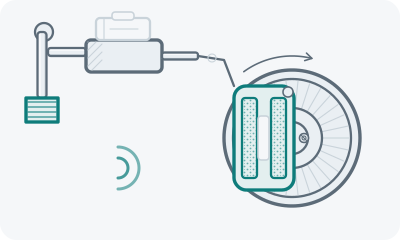
The car is quiet in a straight line, but in right-hand curves and lane changes a low hum rises from under the wheels. That sound is rarely accidental: most often it is a wheel bearing, and the direction of the manoeuvre points straight at where to look for it. Here is the logic of the diagnosis, a step-by-step check without a lift, the sound-alikes and how the repair is decided.
The side that hums points at the opposite wheel
A wheel bearing is the part the wheel turns on; it carries the weight of the car at every moment of driving. In a right-hand curve, centrifugal force leans the body left and most of the mass moves onto the left-hand wheels. If the raceways of the left front bearing are already worn, the added load makes them hum louder, while the right-hand side is unloaded and stays silent. So a hum “to the right” usually means the left bearing, and a hum “to the left” means the right one.
An important caveat: the rule works in gentle curves at 40–60 km/h and above. In slow, tight turns — in a car park or a driveway — other mechanisms and other suspects come into play, from CV joints to the power steering.
A step-by-step check in one outing
You need an empty, level road and ten minutes.
- Accelerate to 60–80 km/h and note the baseline: is there a hum in a straight line?
- Ease right, then left. Note in which curve the hum grows and in which it fades.
- At the humming speed, select neutral and coast: if the hum stays, the engine and gearbox are out of suspicion.
- Repeat the same stretch on a different surface: if the hum is unchanged, it is not the tyres.
- After the drive, carefully bring a hand near the wheels: a hub that is noticeably warm on one side is extra evidence.
Write the result down in two lines: “hum from 60, grows to the right, stays when coasting, ignores the surface.” For a mechanic that phrasing cuts the diagnosis to ten minutes on a lift — all that is left is to raise the wheels, spin them and rock them in two planes.
The sound-alikes
| What you notice | Likely source |
|---|---|
| Hum with the car parked while steering | Power steering pump |
| The sound changes with the road surface | Tyres |
| Crunching or clicking in a tight turn under power | Outer CV joint |
| The hum follows the throttle, not the corners | Differential, transmission |
| A constant hum in a straight line with no reaction to manoeuvres | A late-stage bearing, or tyres |
The most common lookalike is the power steering: its pump howls when you turn the wheel, but unlike a bearing it does so while parked as well, and road speed has no effect — that case is covered in power steering whine when turning. A constant hum with no clear link to manoeuvres is a separate problem with its own list of causes, collected on the symptom page humming while driving, and the sound portrait of a worn hub is on wheel bearing hum.
How the repair is decided
Two things keep the bill honest. First, do not agree to “a pair while we are here” without play or noise on the other side: bearings are replaced individually. Second, find out how your car is built before the work starts — a separate bearing is cheaper as a part but needs a press, while a complete hub assembly costs more and goes on faster, with no risk of a pressing error.
One more detail that decides how long the repair lasts: the hub nut torque. Over- or under-tightening destroys a new bearing within thousands of kilometres, so a torque wrench rather than an impact gun is what you want to see. And on many modern cars the ABS sensor sits inside the hub assembly, which is why a failing bearing sometimes brings warning lights along with the noise.
Not sure your ears are pointing the right way? Record the hum in the Pro-Stuk app during the lane changes: the app matches the recording with your answers and shows the likely causes with percentages and an urgency level — so you arrive with a hypothesis rather than “something is humming”.
