

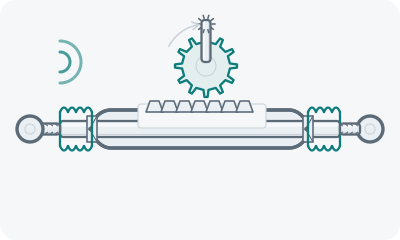
Drivers suspect the steering rack first at any knock from the front — and often wrongly: the rod joints and anti-roll bar links fail more frequently. A mistake in the diagnosis is expensive here: rebuilding a rack costs several times more than replacing a track rod end, and by ear their sounds are similar. Here is what makes a rack knock, which signs point at it specifically, and how to confirm the diagnosis in ten minutes with a helper.
What actually knocks inside a rack
The rack is a toothed bar in a metal housing, moved by the pinion on the steering shaft. A spring-loaded yoke presses the bar against the pinion, and at the ends of the housing the bar slides in bushes. A knock appears when a clearance develops in one of those places:
- the mesh between pinion and bar — the commonest case; the knock is heard closer to the centre, with the wheel straight ahead, where the teeth are most worn;
- the support bushes — the bar starts to move in the housing; the knock is dull, more often on one side, and especially noticeable on small bumps;
- a weakened yoke — the spring stops taking up the clearance, and the knock grows gradually, week by week.
On cars with hydraulic assistance, hydraulics are added to the mechanics: worn seals leak, but that shows itself as heavy steering and a whining pump rather than a knock — power steering whine when turning. A mixed picture, knock plus whine, usually means two separate faults at once.
Two factors accelerate the wear: broken roads, where the rack catches impacts by the thousand, and split bellows, through which dust and water reach the housing, after which wear proceeds several times faster. So at every seasonal tyre change it is worth asking the fitter to look underneath: the state of the bellows is visible without dismantling anything.
Signs that point at the rack specifically
| Sign | Steering rack | Ends and tie rods |
|---|---|---|
| Where the knock is heard | In the centre, “in the wheel itself” | Below, at the wheel |
| Rocking the wheel while parked | The knock repeats easily | Almost no knock, it comes on the move |
| Character of the sound | A single dull impact | Frequent fine chatter |
| Behaviour of the car | Play around straight ahead, sometimes binding | The car pulls, wanders |
| Tyre wear | Usually even | Uneven, at the edges |
The classic picture of a knocking rack is made up of three observations: a dull impact on expansion joints and small potholes, noticeable play in the wheel around the straight-ahead position, and the ability to reproduce the knock on a stationary car simply by rocking the wheel. If all three coincide, the odds on the rack are high. The general breakdown of road knocks and their twins is on the symptom page knocking over bumps.
There is a reverse clue too — what a rack does not do. It does not make the car pull: a car with a knocking rack holds a straight line as long as the geometry is right. If the car pulls to one side and the tyres wear at the edges, the joints and the alignment are checked first, and the steering gear only after that.
A ten-minute test with a helper
- Park the car on level ground and start the engine — with the assistance running the wheel is easier to rock.
- The helper at the wheel rocks it left and right through 10–15 degrees in short movements.
- You place a palm in turn on the track rod end, on the tie rod at the rack bellows, and on the rack housing itself.
The impact reaches your palm in exactly the worn part — locating the source by touch is far easier than by ear. If the knock is felt on the rack housing while the joints stay silent, the diagnosis is nearly ready. What remains is to rule out the fasteners: loose rack bolts and worn subframe bushes give a very similar dull knock, so on the lift a mechanic checks those first. One more detail is temperature: the clearance in the mesh changes slightly with warm-up, and on some cars the rack knocks only in the morning while the housing is cold, then quietens after ten kilometres. That is a feature of thermal expansion worth mentioning to the mechanic: it confirms the diagnosis rather than cancelling it.
How to recognise each joint by feel and by the car’s behaviour is covered separately in signs of worn tie rods and signs of worn track rod ends.
What it is most often confused with
- The steering shaft universal joint. Clicks as the wheel changes direction, the sound coming from inside the cabin, near the pedals. A frequent reason for a false verdict on the rack.
- Strut top mount bearings. Crunch and tap as the wheel turns, but the sound comes from above, from the strut towers under the bonnet — strut top mount bearing noise symptoms.
- Anti-roll bar links. Chatter on washboard and speed humps, and barely reach the wheel — signs of worn anti-roll bar links.
- A knock while turning on the move. A separate story with its own list of causes, from the CV joint to the ball joint; the rack is far from first on it — a knock when steering on the move.
- Loose subframe fasteners. After suspension work, under-torqued bolts give a dull knock that wanders around the whole front end and confuses even experienced mechanics — a knock after suspension repair.
How the repair is decided
The route depends on where the clearance was found. A small amount of play in the mesh is removed by an adjustment — the screw that loads the yoke. An adjustment does not cure worn bushes or a worn bar: that needs a rebuild with a repair kit, and in neglected cases replacement of the whole unit. The criteria for choosing between them are set out in a steering rack knock: adjust or replace.
Putting off a knocking rack is a poor economic bet: the clearance grows, the wear on the bar deepens, and yesterday’s cheap adjustment becomes a rebuild. The rule is simple: if the knock grows from month to month, it is time for the lift.
Two things worth asking when choosing a workshop. The warranty on a rebuild and how long the work takes: with experienced mechanics a rack — removal, rebuild, refitting and alignment — takes a day to a day and a half. A suspiciously fast “repair in an hour” is usually the same adjustment, charged at rebuild prices. And whether new bellows are included: fitting a rebuilt rack behind old split boots wastes the whole job.
If you want to test your suspicions before the workshop, record the knock in the Pro-Stuk app: drive a rough stretch with the recording on and answer a few questions — the app matches the sound with typical fault profiles and shows the likely causes with a level of urgency.
