

A knock that appears exactly as you turn the wheel while driving is a sign with good diagnostic value: it immediately eliminates half the suspects. If the car is quiet in a straight line and the sound appears as the wheel turns, look at the parts that either change angle or take the transferred weight at that moment. Here are the causes from the most common to the rare, how to separate them by sound, and how the repair is decided.
The main suspects
| Sound | When it shows | Likely part |
|---|---|---|
| Loud clicks, rattling | Turn under power, wheel at full lock | Outer CV joint |
| A single dull knock | Start of a turn, coming off a bump | Ball joint |
| Crunch, creak from above | Turning the wheel, even parked | Strut top mount bearing |
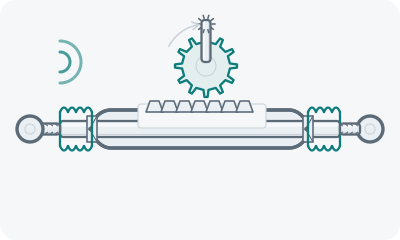
| A knock into your hands | Turning plus a bump | Track rod ends, tie rods, the rack |
| A chatter from the side | Turning on washboard | Anti-roll bar links |
The outer CV joint wears first, because it works at the largest angles. The symptom is so recognisable that it has its own page — clicking when steering — with the full portrait in signs of a worn outer CV joint.
Telling the causes apart
The car park test. Drive a slow circle at full lock, first one way then the other, with light throttle. Rattling and clicks are almost certainly the outer CV joint, and it is loaded harder on the side opposite the turn.
The bump test. If the knock appears only where a turn coincides with a pothole or a wave in the tarmac, the ball joint and the steering joints are the suspects. A ball joint knocks dully and from below — signs of a worn ball joint — while the tie rod joints send a fine chatter into the wheel, covered in signs of worn tie rods.
The parked test. Rock the wheel with the engine running. A knock audible without moving points at the steering mechanism — clearance in the mesh or the rack bushes; the full symptom list is in signs of a faulty steering rack. A crunch from above, at the strut tower, is the top mount bearing — signs of worn strut top mount bearings.
If the sound in a turn is not a knock but a growing hum, that is a different class of fault: that is how a wheel bearing warns you, loaded as the car’s weight transfers — signs of a worn wheel bearing.
Why it knocks specifically in a turn
In a turn the suspension and steering work in their hardest regime. The car’s weight transfers to the outside, and the load on the ball joint and the hub multiplies — a worn joint that was silent in a straight line starts to separate and knock. At the same time the CV joints transmit torque at a large angle and the anti-roll bar links stretch as they resist body roll. Any play in those parts shows itself as sound exactly when the peak load arrives. So it matters to tell a mechanic not just “a knock” but the conditions: under power or coasting, on smooth tarmac or a bump, at full lock or in a gentle curve.
How the repair is decided
The economics are simple: a torn CV boot noticed in time costs a rebuild with fresh grease; missed, it costs a new joint. With a ball joint it is the reverse — economising on time is dangerous for safety rather than the wallet.
Two things to ask for. That the mechanic shows you the play on the lift rather than describing it — every joint on this list is judged by loading it with a pry bar. And that an alignment follows any work on the track rod ends or the rack.
When it cannot be postponed
Most steering knocks give you time to think: a CV joint rattles for months, a top mount bearing crunches for years. The exception is the ball joint. At its wear limit the pin can pull out of the housing, the wheel folds under and the car instantly loses control — usually during a manoeuvre or in a pothole. So a dull knock from below in turns is a reason to get on a lift within days. The general breakdown of running gear knocks is on the symptom page knocking in the suspension.
Cannot describe the sound confidently in words? Record it in the Pro-Stuk app during the manoeuvre itself: the app matches the recording with your answers and shows the likely causes with percentages and an urgency level.
