

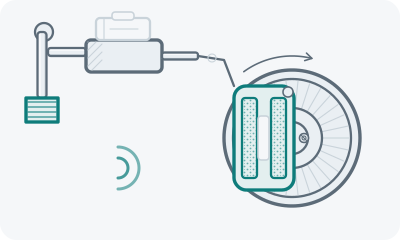
A hum that appears or grows during left-hand curves and gentle lane changes is one of the most talkative sounds in a car: it does not merely report a problem, it tells you which side to look at. Most often this is a wheel bearing announcing itself. Here is why it hums specifically in a corner, how to confirm the diagnosis in a single drive, and how urgent it is.
Why left means right
In a corner the body leans outwards and the car’s weight transfers to the outer wheels. Turning or changing lanes to the left loads the right-hand side: a noticeably larger share of the mass presses on the right wheel bearing, the worn raceways are squeezed harder — and the hum grows. The inner, left wheel is unloaded at that moment, so even a worn left bearing goes quiet in a left-hand curve.
Hence a rule worth remembering and telling the mechanic: the hum grows when you go left, suspect the right bearing; grows when you go right, suspect the left. The rule works from 40–60 km/h in gentle curves; in tight parking manoeuvres other parts get involved and the picture blurs.
Confirming it in one drive
- The lane-change test. On an empty straight road at 60–80 km/h, ease left, then right. The hum fading in the right-hand curve and growing in the left is the picture of a right-hand bearing.
- The coasting test. Accelerate to the speed where the hum is audible and coast in neutral. If the hum stays, the source rotates with the wheels and the engine and gearbox are out of it.
- The surface test. Drive a stretch with different tarmac. A bearing hums the same everywhere; tyre noise changes on a smooth surface.
If all three agree, a wheel bearing is highly likely. The sound portrait is on the symptom page wheel bearing hum.
What else hums in corners
| Source | How it differs from a bearing |
|---|---|
| Power steering pump | Hums when steering while parked, ignores speed |
| Tyre noise | Changes with the surface, the same in both curves |
| Outer CV joint | Not a hum but clicking in a tight turn under power |
| Differential, transmission | The hum follows drive: different under power and coasting |
| Rear bearing | Same weight-transfer logic, but the sound comes from behind |
The main divider is what the sound follows. A hum tied to speed and to the direction of the manoeuvre is the chassis. A hum tied to turning the wheel regardless of movement is the power steering. Crunching and clicking are joints. If you are unsure which group your case belongs to, the full catalogue is on the symptom page humming when turning.
How the repair is decided
Bearings are not replaced in pairs — only the worn one. But it is worth asking for both sides to be checked during the diagnosis: if the other one is close behind, at least you will know what to expect.
Two details decide the job itself. Whether your car uses a bearing pressed into the existing hub or a complete hub assembly changes both the price and the time — and on many modern cars the ABS sensor lives inside that assembly, which is why a failed bearing sometimes brings warning lights with it. And the hub nut torque matters more here than on most work: an over- or under-tightened nut destroys a new bearing within thousands of kilometres.
How urgent it is
A bearing almost never fails suddenly: from the first hum to critical play is usually thousands of kilometres. The dangerous signals, after which nothing should be postponed, are a rumble instead of an even hum, vibration in the body and steering, play in the wheel, and a hub that is hot after a drive. At that stage the cage is breaking up, and the count is no longer in thousands of kilometres. Closing the question within the first weeks is cheaper and calmer.
If the hum is still quiet and you want to be sure you are not imagining it, record the sound in the Pro-Stuk app during the lane-change test. The app matches the recording with your answers and shows the likely causes with percentages — and suggests which side to start with.
