

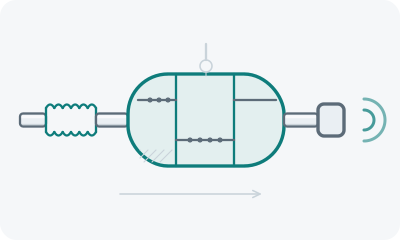
A torn flex pipe gives itself away sharply and unambiguously: yesterday the car sounded normal, today it roars under the driver’s feet loudly enough that you have to raise your voice. The flex pipe is a short flexible section of the downpipe just behind the engine, woven from metal mesh over a bellows. Its job is to absorb the movement of an engine that constantly shifts on its mounts, and to stop that movement destroying the rigid exhaust system.
Why the flex pipe fails first
It works in bending and stretching every time the engine rocks: pulling away, changing gear, on sharp throttle. Its life is finite by definition, but several things bring the end closer.
Worn engine mounts are the main one: the more the engine moves, the more travel the flex pipe has to absorb. Next comes corrosion: thin mesh rots from road salt and condensate faster than thick-walled pipe. Impacts from below play their part, as does a poor repair where the system is fitted under tension or, conversely, left sagging on dead rubber hangers.
What it looks and sounds like
The set of signs is almost always the same:
- A loud roar around the front of the floor that rises sharply when pulling away and changing gear and quietens slightly at a steady cruise. The sound is felt near your feet rather than behind you at the tailpipe.
- Vibration and rattling at idle, felt in the floor and the pedals: the system has lost its damper and now passes engine movement straight into the body. Related sensations are on the symptom page vibration at idle.
- A smell of exhaust in the cabin, especially at traffic lights and at idle with the ventilation on.
- Higher fuel consumption and sometimes a mixture fault code: air is drawn in through the tear and the oxygen sensor ahead of the converter sees a distorted picture. The same logic at the other end of the engine is in signs of an intake air leak.
- A visible tear. From underneath you can see soot and frayed mesh at the tear, and with the engine running a pulsing jet of gas comes out of it.
A quick check: with the engine cold, start the car and hold a palm near the flex pipe from the side without touching the metal. An intact section lets nothing out; a damaged one gives noticeable pulses of air.
What not to confuse it with
| What you hear | Where to look |
|---|---|
| A roar that appeared suddenly, vibration at idle | The flex pipe, the manifold joint |
| Loudness grew over months, popping on lift-off | A hole in the silencer or a pipe |
| Thin sheet-metal rattle in a narrow rev band | A heat shield |
| The sound follows road speed, not revs | The running gear: wheel bearing or tyres |
| Squeaking only when braking | The brake pad wear indicator |
| A pouring rustle over bumps | Broken converter ceramic |
The key to separating them is what the sound depends on. Everything related to the exhaust follows engine revs: add throttle and it gets louder, coast in neutral and it fades. Everything related to the running gear follows road speed and ignores the throttle. Popping in the exhaust has its own symptom page — exhaust backfire.
How the repair is decided
The work is straightforward and almost always done in one visit: the old flex pipe is cut out and a new one welded in, occasionally clamped. While you are there, ask for the engine mounts and the exhaust hangers to be checked — if the cause of the engine’s extra movement is not fixed, the new flex pipe will not last long.
Two things worth asking. Whether the replacement is a proper flex section of the right length and diameter rather than a universal one squeezed in: a flex pipe fitted under tension tears again within months. And whether the system will be hung in its correct position while the weld cools — welded up with the exhaust pulled to one side, the new section starts its life pre-loaded.
If the roar has appeared but you are not sure whether it is the flex pipe or a rotten pipe, record the sound in the Pro-Stuk app at idle and while raising the revs smoothly. The app matches the recording with your answers about where the sound is loudest and how it changes, and suggests which part of the system to inspect first.
