

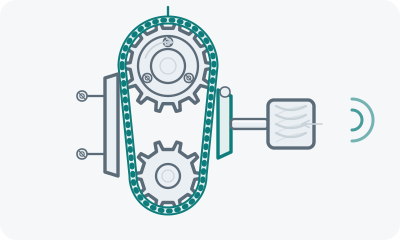
Qashqai owners often describe the same picture: on a cold morning the engine starts and rattles for the first second or two — a dry, chattering sound from the front of the engine — then it disappears and does not return all day. Most often that description points at the cam phaser, the mechanism that rotates the camshaft relative to its drive and changes when the valves open. Here is why it speaks up specifically when cold, how to tell it from a stretched chain, and what a workshop does.
Why the sound appears only at start-up
The phaser is controlled by engine oil pressure. Inside there is a moving part and a locking pin that holds the mechanism in its home position while there is no pressure. After the car has stood overnight the oil has drained into the sump, and in the first seconds after starting the passages are empty. If the locking pin or its seat is worn, the moving part has time to rattle against its stops — and that is the short chatter you hear. As soon as pressure builds, the mechanism is clamped and goes quiet.
Hence the main marker: the sound is strictly tied to a cold start, lasts a few seconds and does not depend on load. If it drags on longer, repeats when warm or changes with the revs, the diagnosis is different. The general sound portrait of such start-up knocks is on the symptom page engine knock when cold, and the system’s own breakdown is in signs of a failing VVT actuator.
What accelerates the wear
Nothing exotic: it all comes down to the oil and how the car is used.
- A stretched change interval. Thickened oil with deposits pumps worse and reaches the mechanism more slowly.
- The wrong viscosity. Oil that is too thick in winter means extra seconds of dry running at every start.
- Short trips. The engine never warms through, condensate and fuel dilute the oil, and the number of cold starts per kilometre is at its maximum.
- A clogged oil filter and dirty passages in the cylinder head.
That does not mean careful use gives infinite life. But the difference between a car with an honest change interval and one serviced “when possible” is clearly audible past a hundred thousand kilometres.
Telling it from the timing chain
| Sign | Cam phaser | Chain and tensioner |
|---|---|---|
| Duration of the sound | 1–2 seconds after starting | Longer, sometimes tens of seconds |
| On a warm engine | Silent | Can rattle at idle |
| Character | A dry short chatter | Rustle, rattle, metallic hum |
| As revs rise | No longer audible | Changes, sometimes grows |
| Fault codes | Often none | Camshaft position codes possible |
Drawing that line before booking matters — it decides both the scope of work and the budget. The second case, with its stages of stretch, is covered in signs of a stretched timing chain.
What a workshop does
The usual order: read the fault codes, look at the oil’s level and condition, ask about the service history. Then remove the rocker cover and inspect the timing drive — the tensioner, the guides, the phaser sprocket itself. Sometimes the first step is an out-of-schedule oil and filter change with the engine listened to for another week: a cheap way of eliminating half the theories.
Two things worth asking when it comes to parts. Whether the oil control valve and its screen were cleaned — a phaser fed through a blocked screen behaves exactly like a worn one, and that check costs almost nothing. And whether the chain will be assessed while the cover is off, because paying for the same access twice is the most common regret on this job.
It is worth remembering that not every morning knock comes from the engine: worn suspension joints give a similar dry sound in the first metres — their signs are in signs of a worn ball joint.
If you want to understand what is rattling before talking to a mechanic, record the sound with the Pro-Stuk app at the moment of a cold start, standing by the open bonnet. The app matches the recording with your answers to a few questions and shows the likely causes with percentages.
