

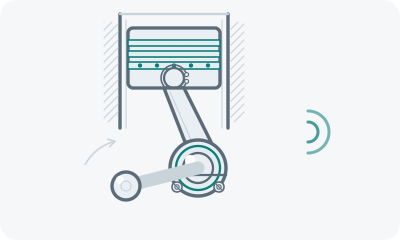
Detonation is explosive combustion of the fuel mixture instead of smooth burning. The piston takes a hammer blow rather than an even push, and a shock wave travels through the engine’s parts — that is what you hear as a sharp metallic ticking. The insidious part is that it destroys invisibly: the car keeps driving while the pistons erode inside. Fortunately it has enough signs to catch the problem early. Below: how to recognise detonation by sound and by the car’s behaviour, where it comes from, and how the repair is decided.
What happens in the cylinder
Normally the spark lights the compressed mixture, the flame front crosses the chamber at tens of metres per second, and the pressure on the piston rises smoothly. In detonation the part of the mixture furthest from the plug does not wait for the flame front and ignites by itself, from heat and compression. The speed of that explosive wave is hundreds of metres per second, and it strikes the piston, the cylinder walls and the head like a hammer on a bell. Hence the characteristic ringing.
Detonation should not be confused with pre-ignition — the mixture being lit by glowing carbon or an overheated plug. The sound is similar and the causes overlap, but the mechanics differ and they are cured differently. Working out which is happening is the job of a diagnosis; the driver’s job is to notice the signs in time.
The main signs
- Pinging under acceleration. The most recognisable symptom: a high metallic ticking, like small balls being shaken in a tin. It appears under load — uphill, overtaking, accelerating in too high a gear — and fades when you lift off. The garage term is “pinking”; the full sound portrait is in metallic pinging under acceleration and on the symptom page pinging when accelerating.
- Loss of power. The ECU suppresses detonation by retarding the ignition, and pays for it with flat acceleration.
- Rising fuel consumption. A consequence of the same retarded timing: part of the fuel’s energy goes out of the exhaust without doing work.
- A tendency to overheat. Detonation sharply increases heat transfer into the cylinder walls — the temperature creeps up in hot weather, in traffic and on climbs.
- Check engine. The ECU may log knock sensor faults or misfires.
- Traces on the plugs. A whitish insulator with black speckles, erosion and melted electrode edges — the picture a mechanic recognises as detonation at the first look at the plugs.
From a one-off ping to a repair: the stages
| What you see | What it means | What to do |
|---|---|---|
| A one-off ping after a particular fill-up | Fuel with a low octane rating | Change filling station, watch |
| Pinging repeats under load | Carbon, plugs, overheating, fuel system | Diagnosis within days |
| Pinging plus flatness and higher consumption | The ECU is constantly suppressing detonation | Diagnosis without delay |
| Pinging in almost any regime, overheating | Damage is probably already happening | Gentle regime and straight to a workshop |
A separate caveat: if the knock is not sharp but dull, from deep in the block, and does not react to the fuel at all — that is probably not detonation but worn bearings or pistons, and it is noticeably more dangerous. Where the line runs is in can you drive with engine knock.
Where detonation comes from
- Fuel. An octane rating below what is required is cause number one. The manufacturer’s requirement is on the fuel filler flap and in the handbook: the octane number reflects the fuel’s resistance to self-ignition, and on a high-compression engine one grade lower is a direct route to pinging.
- Carbon. Deposits in the combustion chamber reduce its volume and hold heat. A typical story for high-mileage cars used for short town trips.
- Spark plugs. Worn plugs, or plugs of the wrong heat range (the characteristic describing how fast a plug sheds heat), overheat and provoke early ignition.
- A lean mixture and overheating. Blocked injectors, an air leak, a faulty thermostat — anything that leans the mixture and heats the chamber pushes the engine towards detonation.
- LPG. Badly set up gas equipment leans the mixture. If the pinging appeared after an LPG installation or a re-tune, start with adjusting the gas system.
- The knock sensor. When it fails, the ECU stops hearing the engine and stops protecting it — the engine can detonate without a single fault on the dash.
Why silence does not mean everything is fine
A modern engine pings rarely and briefly: the knock sensor — a piezo element on the block — catches the characteristic vibrations within milliseconds and the ECU retards the timing. The sound disappears, but the problem remains: the engine runs with strangled timing, loses power and burns extra fuel, and when the protection fails the detonation returns. So on recent cars the indirect signs — consumption, flatness, overheating — matter more than the noise itself.
They should not be ignored. Shock waves break the lands between the piston rings, melt piston edges and damage big-end bearings — advanced detonation often ends in a rebuild. The general breakdown of engine noises is on the symptom page knocking in the engine, and the case where a petrol engine starts sounding like a diesel is in a petrol engine that sounds like a diesel.
What to do, in order
The sensible sequence is simple: fill up at a filling station you trust with fuel of the correct octane rating — if the pinging goes, the cause is found. If it does not, check the plugs, the injectors, the knock sensor and the cooling system.
Two things a workshop does not always volunteer. First, the knock sensor is checked by looking at live data, not just by the absence of a stored code — a lazy sensor can pass a code scan and still fail to protect the engine. Second, if carbon is confirmed and cleaned, ask what created it: short trips, stretched oil intervals or a leaking injector will rebuild the same deposits within a year, and cleaning without curing the cause is money spent twice.
Any of these steps costs incomparably less than the consequences: piston and ring damage is a rebuild.
If you are not sure whether it is detonation or a mechanical knock, record the acceleration in the Pro-Stuk app. It matches the recording with typical engine sounds, asks a few clarifying questions and shows the likely causes with an urgency level — with that in hand the conversation at the workshop is shorter and more specific.
