

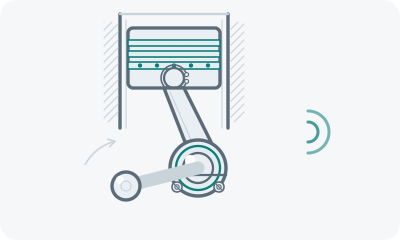
A ringing metallic sound under acceleration — as though small coins were being shaken in a tin can, or someone were tapping the engine with a thin hammer — gets called different things: “pinking”, “pinging on hills”, “rattling under load”. In most cases one phenomenon lies behind it: detonation. It does not stall the engine or leave you at the roadside, so people put up with it for months. They should not: the damage builds up quietly and the bill arrives large. Here is where the pinging comes from, when it is not detonation, and what to check first.
What detonation is and why it rings
In a healthy engine the mixture of petrol and air is lit by the spark plug and burns as a fast but smooth flame front. In detonation part of the mixture self-ignites from pressure and heat — a micro-explosion. The shock wave strikes the cylinder walls and the piston crown, and that impact is what we hear as a ringing metallic rattle.
On modern turbocharged direct-injection engines there is a particularly nasty variant — low-speed pre-ignition: rare but loud single “shots” of pinging when accelerating at low revs in a high gear. On such engines oil with exactly the right manufacturer approval is critical.
The conditions for detonation peak under acceleration: throttle to the floor, high cylinder pressure, revs not yet risen. Hence the classic picture — pinging when accelerating from low revs, uphill, with a loaded car or the air conditioning on, disappearing at a steady cruise. The old name “piston slap” is a misnomer: genuine gudgeon pin knock is a separate and far rarer fault.
Causes: from fuel to the sensor
| Cause | Mechanism | Fix |
|---|---|---|
| Low-octane fuel | The fuel self-ignites too early | Fill with the grade the handbook specifies |
| Carbon in the combustion chambers | Compression ratio rises, deposits glow | Decarbonising |
| Plugs of the wrong heat range | An overheated plug lights the mixture itself | A correct set of plugs |
| Knock sensor | The ECU is not retarding the timing | Diagnosis, sensor replacement |
| Engine overheating | Hot walls provoke self-ignition | Cooling system |
| A lean mixture | A lean mixture burns hotter | Find the air leak, clean the injectors |
The first thing to remember is fuel: the quality spread between filling stations is real, and pinging that appeared right after one particular station is a diagnosis in itself. The second most common case is an engine that has run for years on lower octane than specified: carbon in the chambers gradually raises the effective compression ratio, and detonation then arrives even on the correct fuel.
LPG conversions deserve a separate mention. Properly set up, gas does not provoke detonation, but wrong ignition timing or a lean gas mixture gives exactly the same pinging under load. If the sound appeared after an LPG installation or a re-tune, start with adjusting the system rather than with decarbonising.
When it is not detonation
Similar sounds come from other sources. An exhaust heat shield rattles at particular revs — but also without load, blipping the throttle while parked. Worn gudgeon pins ring on changes of load — on lift-off and pick-up, not only under acceleration. A timing chain rustles at idle too; how to listen for that is in checking timing chain tension by ear. If misfires have joined the pinging — the engine shakes, power is down — the picture shifts towards the ignition system, and that combination is covered in the engine misfires and knocks.
Another lookalike is the undertray or a torque link touching the body as the engine rocks under acceleration: the sound is metallic but comes from below, and on a lift the cause is found in minutes.
The key test: detonation is rigidly tied to load. Accelerate uphill and the pinging is there; the same acceleration downhill and it is quieter or absent. Mechanical rattles depend far less on load. Compare your sound with the typical ones on the symptom pages pinging when accelerating and knocking when accelerating.
How dangerous it is and whether you can keep driving
An engine survives a short episode of detonation on bad fuel: the knock sensor hears it, the ECU retards the ignition, and the sound goes away along with some of the power. What is dangerous is constant pinging: the shock waves break the lands between the piston rings, damage the bearings and overheat the valves. Outwardly the car drives normally — right up to the day compression drops and blue smoke comes out of the tailpipe.
An extra marker is fuel consumption: an ECU constantly retarding the timing away from the danger zone sacrifices economy, and a pinging engine starts using a litre or a litre and a half more than usual.
So the rule is simple: driving to a filling station and a workshop with pinging is fine; driving with it for weeks is not.
What to check, in order
Work from cheap to expensive. First: fill a full tank of the correct octane at a filling station you trust and watch for a tank or two. Second: take the spark plugs out and look at them — a whitish deposit and melted electrodes point to overheating and a lean mixture; check the heat range against the catalogue while they are out. Third: a diagnostic scan will show knock sensor faults and the ignition timing the ECU is running.
If the carbon is confirmed with an endoscope, decarbonising costs incomparably less than the consequences. And ask one more question before agreeing to anything larger: what caused the deposits in the first place. Short trips, long oil change intervals and a leaking injector all rebuild the same carbon within a year, and cleaning without curing the cause is money spent twice.
If you are not sure whether it is detonation or something mechanical, record the acceleration in the Pro-Stuk app: it matches the recording with your answers about when the pinging appears and shows the likely causes with percentages and an urgency level — a convenient starting point before a workshop visit.
