

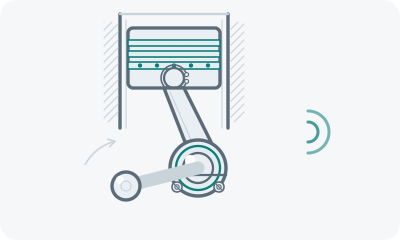
A gudgeon pin is a steel cylinder joining the piston to the connecting rod and passing on all the combustion pressure. The part is designed to last the engine’s life, so genuine pin knock is rare, and the phrase “the pins are knocking” has been misapplied to detonation for decades. Nonetheless a worn pin really does knock, its sound is recognisable, and it should not be confused with other knocks: both the urgency and the budget are its own. Here is how it appears, how it sounds and which tests confirm it.
Where the play comes from
The pin is supported at three points: in two bosses in the piston and in the small end of the connecting rod, usually through a bronze bush. Play appears for three reasons:
- oil starvation — the small end bush is lubricated by splash and mist and is the first to wear when the level or pressure is low;
- overheating — the aluminium piston bosses lose their interference fit after a serious overheat;
- detonation — its shock waves batter the pin-to-boss fit, so advanced detonation eventually adds a genuine pin knock to its own pinging, as covered in signs of engine detonation.
A clearance of tenths of a millimetre is already audible: at every reversal of force the pin shifts in its worn bore with a metallic click.
What pin knock sounds like
The sound is high, sharp and dry — thinner than valvetrain ticking and more distinct than detonation pinging. The main marker is its link to changes of load: the knock is clearest at the moments when the force on the piston reverses.
| Sign | Gudgeon pin | Detonation | Valves |
|---|---|---|---|
| Character | Sharp single click | A series of ringing “coins” | Even soft ticking |
| When heard | Lift-off and pick-up, throttle blips | Acceleration under load | Constantly, with revs |
| Dependence on fuel | None | Yes, octane rating | None |
| Warm-up | Barely affects it | Louder when hot | Quieter when hot |
| Cutting a cylinder | The knock changes | Unchanged | Unchanged |
The difference from detonation is fundamental: filling with higher-octane fuel does nothing for a pin knock, while it usually kills detonation pinging. The difference from piston slap is temperature: slap booms when cold and fades after warm-up, a pin knocks the same way always. If your knock lives only on a cold engine, start from is a cold knock that goes away dangerous.
The tests that confirm it
The home check is a throttle blip while parked: press and release the throttle sharply on a warm engine. A pin answers with a sharp click exactly at the changes of load — on pick-up and on lift-off. Then the same test on a cold engine: if the sound is identical, the pin theory strengthens; if it is louder cold, the piston assembly is more likely.
At a workshop the cylinders are cut one at a time: with the engine running one cylinder’s coil or injector is disconnected in turn. The load on that piston falls, and a worn pin’s knock changes noticeably or disappears — that is how the specific cylinder is found. Then a compression test and an endoscope inspection through the plug hole separate pin wear from bore scoring, whose signs are in signs of cylinder bore scoring. A dull low knock from deeper down is a different and more urgent story — signs of big-end bearing knock.
Compare your sound with the typical recordings on the symptom pages pinging when accelerating and knocking in the engine.
How the repair is decided
A pin cannot be replaced from outside: the engine has to come apart and the piston assembly out. The pins, the small end bushes and, where the bosses are damaged, the pistons are replaced, all with the cylinders inspected. That is rebuild territory, and the important consequence is timing: while the play is small the estimate is limited to pins and bushes; hammered bosses add a set of pistons.
Two things worth settling with the workshop. Which cylinder was identified and how — cutting cylinders is a five-minute test, and a diagnosis without it is a guess. And whether the cause was found: oil starvation or detonation that damaged the pin will damage the new one too.
Driving with a knocking pin is possible briefly and gently: no high revs, no full loads. The play grows at an accelerating rate, and every kilometre under load moves the repair towards the more expensive version.
If you are not certain of the diagnosis — and with engine knocks nobody ever is — record the sound in the Pro-Stuk app: it matches the recording with your answers about the conditions and shows the likely causes with percentages.
