

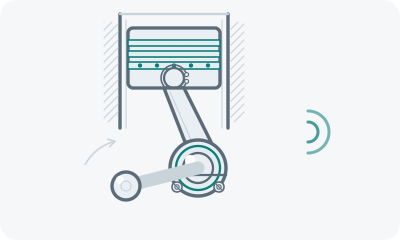
Scoring means deep vertical scratches on the cylinder bore — the mirror-smooth surface the piston slides on. Once they appear they do not go away: the oil film tears at that point, wear accelerates, and the engine gradually heads for a rebuild. The good news is that scoring almost always warns you in advance — the point is to hear it.
Where scoring comes from
The mechanism is always the same: the oil film tears where the piston meets the wall, and metal rubs on metal. There are several reasons:
- oil starvation — a low level, infrequent changes, a blocked oil filter, or running worn-out oil in hot weather;
- overheating — the piston expands beyond its design and presses against the wall;
- abrasive — ceramic dust from a disintegrating catalytic converter drawn back into the cylinders, or dust that got past a poor air filter;
- design characteristics — some engines are prone to scoring even with careful use.
Five signs of scoring
- A knock when cold. The earliest and most characteristic sign: a dull diesel-like knock for the first minutes after starting that fades as the engine warms. The piston with its worn skirt rocks in the bore until it expands with heat.
- Rising oil consumption. The scratches let oil into the combustion chamber: first a top-up every few thousand kilometres, then not making it from one service to the next.
- Metallic dust in the oil. A glitter on the dipstick, swarf on the magnetic plug or in the old filter at a change.
- Rough running and lost power. Compression in the affected cylinder falls and the engine starts misfiring, especially when cold.
- Blue smoke on a throttle blip. Burning oil gives the exhaust a bluish tint, noticeable when the revs are raised sharply from idle.
No sign alone is a verdict, but two or three together are solid grounds for an endoscopy without delay.
The stages: from first scratches to a rebuild
| Stage | What you hear and see | What to do |
|---|---|---|
| Early | A light knock when cold for 1–3 minutes | Endoscopy, monitor the oil |
| Middle | The knock lasts longer, oil topped up between services | Prepare a repair budget |
| Advanced | Knock when warm too, misfiring, smoke | Repair soon |
| Critical | Constant knock, swarf in the oil | Stop using the car |
The rate of progression is unpredictable, but the direction is always the same. The closer to the lower rows, the more relevant the question in can you drive with engine knock — at an advanced stage every cold start takes life out of the engine. Where the line runs between a harmless cold noise and a warning is in is a cold knock that goes away dangerous.
Which engines are at risk
Certain petrol engines are known for it, and their owners’ forums are full of the same story: a cold knock, then oil consumption, then an endoscope. A collapsed catalytic converter is a risk of its own on engines where it sits close to the manifold — the ceramic dust works as an abrasive, as covered in a broken catalytic converter: the sound. If your car belongs to a model with a known reputation, make it a rule: an endoscopy once a year, or at any new cold-start knock. Compare your sound with the typical recordings on the symptom pages engine knock when cold and knocking in the engine.
Confirming it and what follows
The order of confirmation: a compression test cylinder by cylinder, then an endoscopy through the spark plug holes. Together they take about an hour. If scoring is confirmed, the repair options are re-boring the block to an oversize or sleeving it with new pistons. That is a rebuild, and there are no intermediate cures: additives and decarbonising do not remove scratches from metal.
Two questions decide the job. First, whether the cause was found: if the scoring came from a disintegrating converter or an oil starvation problem, a rebuilt engine meets the same conditions. Second, whether the bearings were inspected at the same time — the debris the scoring has already produced circulates with the oil, and a rebuild that ignores it is a short one. If a dull knock from deep in the block has joined in, that is a different and more urgent question — signs of big-end bearing knock.
If the engine has started knocking when cold and you suspect the worst, record the sound in the Pro-Stuk app. It matches the recording with your answers about the conditions and shows the likely causes with percentages and urgency: with that picture the decision about an endoscopy and a repair is easier and calmer.
