

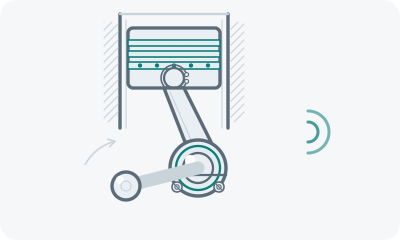
Big-end knock is the sound drivers fear most, and with reason: it means worn big-end bearings — the plain bearings through which the connecting rod turns on the crank journal. The good news is that this knock has a recognisable signature and can be separated from harmless sounds before anything is dismantled. The earlier it is recognised, the cheaper the outcome — sometimes by the price of a whole engine.
What big-end bearings are and why they knock
A bearing shell is a thin steel half-shell with an anti-friction layer. Normally the rod never touches the crank journal: oil pressure maintains a film hundredths of a millimetre thick — the oil wedge. While that wedge holds, the assembly barely wears.
The knock appears when the clearance grows so large that the oil no longer fills it. At every reversal of load — which happens on every revolution — the rod shifts in the clearance and strikes the journal. The enlarged clearance usually comes from oil starvation, old or unsuitable oil, driving with a low level, or simply high mileage. A drop in oil pressure is both a cause and a companion of that wear: its signs are in signs of low oil pressure.
It matters to understand the pace: a damaged bearing gets hot, heating the oil around it, the worn layer holds the wedge less well, and the failure accelerates itself. So big-end knock never “stabilises” — it always progresses; only the speed is in question.
What it sounds like
The reference points engine builders use to describe it:
- a dull metallic knock of medium pitch — lower and softer than valvetrain ticking, heard from deep in the block;
- the frequency matches crankshaft speed — it quickens in step with the throttle, with no pauses;
- it grows under load — accelerating, uphill, with the air conditioning on; the symptom page is knocking when accelerating;
- it stands out on lift-off and on a throttle blip — a short series of distinct thumps as the revs fall;
- it is louder when hot — thin hot oil holds the wedge less well in a worn clearance.
Early on the knock may only be audible in particular regimes — for instance only on a throttle blip with the engine warm. It becomes constant later, and that is already a late stage.
Main bearings deserve a separate mention — the bearings the crankshaft itself turns on. Their knock is lower and duller, felt at the very bottom of the block and louder at startup and under load. Separating big-end from main bearing knock by ear is hard even for an experienced engine builder, but for the owner it does not matter: both mean the crankshaft bearings are running without an oil wedge, and driving on is not an option.
The signs that come with the sound
The big-end scenario rarely arrives alone. Indirect confirmations:
- the oil pressure light comes on or flickers at hot idle;
- metallic glitter or swarf on the dipstick, in the drained oil and in the filter — the debris of the anti-friction layer;
- oil pressure below specification when measured with a gauge;
- the sound progresses — week by week the knock is heard earlier and louder.
| Stage | What you hear | What is happening inside |
|---|---|---|
| Early | Dull thumps on a throttle blip when hot | Clearance at the limit |
| Middle | Knock under load, oil light at idle | The anti-friction layer wearing |
| Late | Constant loud knock in every regime | The bearing breaking up |
| Final | Clattering, then seizure or a holed block | A spun bearing, scored journals |
What big-end knock is confused with
Half of all “big-end” knocks turn out at diagnosis to be something else — good news for the owner. The main lookalikes:
- hydraulic lifters — sharp ticking from above at half crankshaft speed, barely affected by load; the checks are in how to check hydraulic lifters;
- detonation — a ringing pinging only under acceleration, depending on the fuel and disappearing on lift-off, covered in signs of engine detonation;
- a gudgeon pin — a sharp double knock, more often when cold;
- engine mounts — a single dull thump when pulling away or changing gear, not a rhythmic knock.
The general rule: sharp sounds more often mean the valvetrain and detonation; dull ones from deep down mean the crankshaft and its bearings. The full catalogue of engine sounds is on the symptom page knocking in the engine.
How the diagnosis is confirmed
The standard sequence takes under an hour. The engine is listened to with a stethoscope, localising the knock by zones of the block. Then the cylinders are cut out one at a time (by unplugging coils or injectors): if the knock changes noticeably or disappears when one cylinder is cut, that cylinder’s rod is to blame, because without combustion the shock load on its rod drops sharply. Then the oil pressure is measured with a mechanical gauge and the filter is inspected for swarf. The final verdict comes from a strip-down with the sump off: the bearings can be seen.
What the owner can do before the visit is record the sound in two regimes: at hot idle and on a throttle blip. The knock cannot always be reproduced in the workshop on request, and a recording with a description of the conditions (“appears after twenty minutes of driving”) saves the engine builder time and reduces the chance of a wrong diagnosis.
What follows
With confirmed big-end knock, driving is not an option — the risks are set out in can you drive with engine knock.
One important caveat: simply “dropping in new shells” without inspecting the journals is a false economy. If a journal’s surface is already damaged, new bearings on it will not last, and within a few thousand kilometres the whole thing repeats with a worse ending. An honest workshop measures the journals with a micrometer first and only then quotes.
Two more questions worth asking. Whether the cause was found — a blocked oil pick-up, a worn pump or a stretched oil change interval will finish the new bearings the same way. And whether the sump and the oil galleries will be cleaned of the debris the old bearing has already sent round the engine.
The economics are simple: the sooner you stop and check, the higher the chance of getting away with bearings and leaving the crankshaft alone.
If you are unsure whether it is big-end knock or one of its lookalikes, record the engine in the Pro-Stuk app: it compares the recording with typical knocks, asks clarifying questions and shows the likely causes with an urgency level. That does not replace a strip-down, but it helps you judge how urgently a workshop is needed.
