

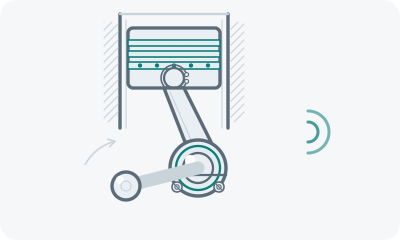
Pinking — a bright metallic ticking under acceleration — has been described in workshops for half a century as “the little pins ringing”. The phrase stuck, although the sound almost never has anything to do with the gudgeon pins: in nine cases out of ten what rings is detonation, explosive combustion of the fuel mixture. The good news is that the commonest cause is cured by changing where you fill up. Here is what actually rings, the full list of causes from common to rare, and how to tell the harmless scenario from the genuinely worrying one.
What actually rings
In normal combustion the flame spreads from the plug as an even front and the piston receives smoothly rising pressure. In detonation part of the mixture in the far corners of the chamber ignites on its own without waiting for the flame — and a pressure wave strikes the metal. The cylinder walls and the head answer with a high ringing, heard through the bonnet as ticking or like ball bearings rattling in a tin.
The old name was inherited: on early engines a worn gudgeon pin joint also rang, and drivers did not separate the two phenomena. Today the term lives its own life, while the full breakdown of detonation itself — the mechanics, the signs and the consequences — is in signs of engine detonation. A short description of the symptom is on the page pinging when accelerating.
Causes, from common to rare
| Cause | Mechanism | What to do |
|---|---|---|
| Fuel below the required octane | The mixture self-ignites under compression | Fill up at a different station |
| Carbon deposits in the chambers | Smaller chamber volume, red-hot spots | Diagnosis, decarbonising |
| Worn or wrong spark plugs | An overheated plug ignites the mixture early | Replace to the correct heat range |
| A lean mixture | Burns hot, prone to detonation | Check injectors and air leaks |
| A badly set LPG system | The gas mixture is lean | Retune the gas equipment |
| Engine overheating | Hot walls provoke ignition | Check the cooling system |
| A faulty knock sensor | The electronics stop protecting the engine | Replace the sensor |
The octane rating is petrol’s resistance to self-ignition under compression: the higher an engine’s compression ratio, the higher its requirement. Putting lower-grade fuel into an engine designed for higher is the shortest route to pinking, especially in summer heat and with a loaded car. Cars converted to LPG add another item: pinking often appears after a conversion or a re-tune, because a lean gas mixture burns hot and detonates more readily than petrol.
When it really is the gudgeon pins
A worn gudgeon pin is a rare scenario, but it exists. Three signs separate it from detonation:
- The sound is independent of the fuel. Changing stations and moving to a higher octane changes nothing.
- It rings outside load too. A clear bright knock, often doubled, is heard on a throttle blip while parked and at a steady cruise, and its frequency is tied to the revs.
- The sound is stable or growing. Detonation comes in episodes and dies on lift-off; a mechanical knock goes nowhere.
The full portrait is in gudgeon pin knock: how to identify it. Wear in other piston group joints shows itself similarly — if the knock is dull and grows with load, start with an engine knock under load. And if the sound only appears once the engine is fully warm, the breakdown in an engine knock when hot helps: on hot oil the clearances are heard best. The general symptom page is knocking when accelerating.
Narrowing the cause yourself
- The fuel test. Put half a tank of fuel of the correct or higher octane in at a different station. The pinking has gone — question closed, and remember the bad station.
- The load test. Pinking only when labouring and on climbs is the handwriting of detonation. A knock at any revs, including idle, is a reason to think about mechanics.
- A look at the plugs. A whitish insulator with small black specks and eroded electrodes are traces of detonation; black velvety carbon means a rich mixture; oily deposits mean oil consumption. Plugs come out in ten minutes and tell you more about an engine than an hour of listening.
- Watching the trend. If after “curing” the pinking the car has become sluggish and thirsty, the electronics have most likely just retarded the ignition — the detonation has not gone, it has hidden.
Allow for the season too: pinking shows up more often in summer. Hot intake air and a hot combustion chamber lower the detonation threshold, so a car that stayed silent all winter on a given fuel starts pinking on every climb in July heat. If the pinking is strictly a summer thing and goes in the cool of the evening, the fuel theory becomes more likely still — but the right conclusion is not to wait for autumn, it is to move to the octane rating the manufacturer requires.
How the repair is decided
There are few expensive scenarios here, and nearly all of them are the consequence of a drawn-out search: regular detonation gradually destroys the pistons, and the bill grows by an order of magnitude. So the criterion is simple — work through the cheap, reversible checks in order, and only call it mechanical when a tank of correct fuel, a fresh set of plugs to the right heat range and a scan tool read all fail to change anything.
Two things mechanics do not always say. If detonation is diagnosed, ask whether the knock sensor and the cooling system were actually checked or only the fuel blamed — a sensor that has stopped reporting lets the engine detonate silently, and that is the version that damages pistons. And if a decarbonising service is proposed, ask what evidence of carbon there is: plug condition and a borescope look at the piston crowns are the honest answer, an assumption from mileage is not.
If you want something to lean on before the workshop, record the sound of acceleration in the Pro-Stuk app. It compares the recording with typical sounds, asks a few clarifying questions about when and how the pinking appears, and shows the likely causes with a level of urgency. That way you arrive with a specific hypothesis rather than “something rings”.
