

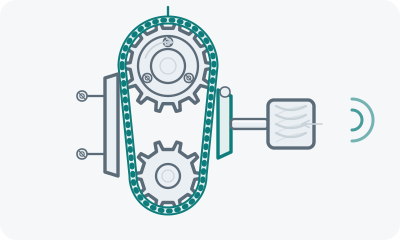
The timing chain connects the crankshaft to the camshafts and sets the timing of the valves. Over time the link pins wear, the chain grows longer and the tensioner can no longer take up the slack. A sound appears that is hard to confuse with anything else, if you know which regimes to listen in. Here is the sound portrait and how to separate a chain from other noises in the engine bay.
The sound portrait
A stretched chain sounds like a dry chatter, rattle or rustle of metal on metal from the front — occasionally the rear — of the engine, from behind the timing cover. The key markers:
- Cold start. The first 2–5 seconds after starting are the loudest, then it fades sharply as the tensioner fills with oil.
- Lift-off. Release the throttle from 2,500–3,000 rpm and a short wave of rattle appears as the revs fall.
- It follows revs, not load. The sound is audible with the car parked when you blip the throttle in neutral.
- A constant location. It always comes from one point — the timing drive end, not the middle of the block.
As wear progresses the rattle stops disappearing after warm-up and becomes a permanent background. That is the turning point: the chain is already close to jumping a tooth on the sprocket.
Telling it from other engine noises
| Source | Where it is heard | Reaction to warm-up and revs |
|---|---|---|
| Timing chain | Timing cover, end of the engine | Louder cold, a wave on lift-off |
| Hydraulic lifters | Top of the cylinder head | Rapid ticking, often gone after warm-up |
| Big-end bearings | Middle of the block | Dull knock, grows under load |
| Main bearings | Bottom of the block | Heavy hum-knock, worse when warm |
| Accessories, idlers | Along the accessory belt | Squeal or rustle, follows the belt |
The lower rows of that table set the cost of a mistake. A chain is scheduled work; bearings are a rebuild. The general catalogue of sounds that appear specifically on a cold engine is on the symptom page engine knock when cold.
What a workshop checks
Diagnosing a chain is not limited to listening.
- Listening with a mechanic’s stethoscope. The point of maximum volume at the timing cover is the first confirmation.
- Reading codes and data. Camshaft-to-crankshaft correlation faults and cam sensor codes are indirect but weighty arguments.
- Inspecting the tensioner. The number of ratchet teeth it has extended shows how much travel it has already used.
- Timing marks. On some engines the sprocket marks reveal a timing shift without full disassembly.
A separate note: a hum tied to road speed rather than engine revs has nothing to do with the chain — that is the chassis. Separating those cases is covered in humming: wheel bearing or tyres.
How the repair is decided
It is worth understanding what delay actually risks. A stretched chain first simply makes noise, then starts jumping a tooth — the timing shifts, the engine loses power, fault codes appear and starting gets worse. On many engines a jump or a break ends with the valves meeting the pistons, and then a cylinder head repair joins the bill. The difference between a planned replacement and an emergency one is the difference between one line on the estimate and several.
There is no sense in economising on the kit: fitting a new chain while leaving worn guides and tensioner in place practically guarantees a return to the same job. On engines where the water pump sits behind the same cover, it belongs in the kit for the same reason — the access is already paid for.
One more observation from practice: oil starvation and stretched service intervals accelerate chain wear more than mileage alone.
If the rattle is short and you are not sure you are really hearing it, record a cold start in the Pro-Stuk app — the first five seconds from turning the key. The app matches the recording with your answers and shows the likely causes with percentages, so you arrive with a ready theory rather than a general “something is rattling”.
