

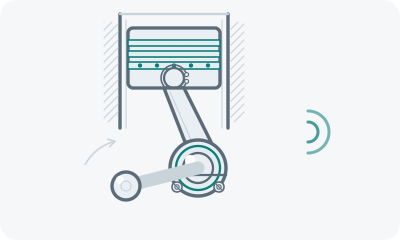
Big end bearings are the thin half-shells that run between the con rod and the crankshaft journal. Between them there should be an oil film a few microns thick. When the clearance grows, the rod strikes the journal on every power stroke — and the engine acquires one of the least friendly sounds a car can make. Here is what it sounds like, how it is localised and why there is no waiting it out.
The sound portrait
A big end knock is bright, metallic and rhythmic, coming from the middle of the cylinder block, roughly at spark plug level or slightly below. The key markers:
- A rhythm at half engine speed. The frequency of the knock is tied rigidly to engine revs and rises with them.
- A reaction to load. The most characteristic sign: blip the throttle in neutral or load the engine, and the knock grows louder and more distinct. It answers the moment you lift off, too.
- Warming up does not help. Unlike many cold knocks, this one usually does not go on a hot engine and often gets louder, because the oil thins.
- Companion signs. Falling oil pressure, the warning light coming on at idle, metallic dust on the sump plug magnet.
How it is localised
The order of work at a workshop looks roughly like this:
- Listening with a stethoscope along the block: the point of maximum loudness gives the first approximation. The method itself is in a DIY mechanic’s stethoscope.
- Cutting cylinders one at a time — injectors or coils. The knock drops noticeably on one of them: the cylinder is found.
- Measuring oil pressure with a mechanical gauge — low pressure confirms the theory and explains the cause, as set out in signs of low oil pressure.
- Inspecting the oil and filter for metal particles.
- Dropping the sump — the final answer: the bearings are inspected and the clearance measured.
Neighbouring sounds need ruling out: a heavy low-frequency knock from below is already the main bearings, covered in signs of main bearing knock, while popping and rough running is more likely the valve train, described in burnt valve signs by ear. The general catalogue of engine knocks is on the symptom page knocking in the engine, and a fuller portrait of this particular fault in signs of big end bearing knock.
What it is confused with
| Source | Where it is heard | Reaction to load |
|---|---|---|
| Big end bearing | Middle of the block | Grows sharply under throttle |
| Main bearing | Bottom of the block, sump | Dull rumbling knock, rises with revs |
| Hydraulic lifters | Top of the head | Ticking, often goes after warm-up |
| Gudgeon pins | Middle of the block | Double bright knock, clearer at idle |
| Timing chain | Timing cover | Rattle at start-up and on lift-off |
Worth saying separately: a knock heard only over bumps and unrelated to engine speed has nothing to do with the engine — that is the suspension, for example signs of a worn ball joint. The check is simple: blip the throttle with the car standing. The engine will answer, the suspension will stay silent. The gudgeon pin version, which is the closest twin, is separated in gudgeon pin knock: how to identify it.
What it threatens and how the repair is decided
A big end knock is not a case where watchful waiting is appropriate. The destruction of a bearing runs away with itself: the increased clearance drops the oil pressure, and the pressure loss finishes off the remaining bearings. The end of the road is a spun bearing, a scored crank journal and, in the worst version, a holed block.
So the practical advice is: until you reach a workshop, do not use the car and do not “warm it up properly” in the hope that the knock will go. A recovery truck is always cheaper than the consequences of driving there yourself — that is the single decision this fault really turns on.
When the sump is off, the choice is made on measurements, not on opinions. If the journals are within limits and only the shells are worn, new bearings of the correct size close the question. If a journal is scored, the crank goes for regrinding and undersize shells follow — and then the oil pump, the pickup and the oil galleries have to be cleaned, because the metal that came off has gone somewhere. Ask for the old shells to be shown to you: their wear pattern tells you honestly whether it was oil starvation, contamination or fuel dilution.
One more thing mechanics do not always say: a rebuilt bottom end needs a gentle running-in and an early first oil change, and the fault that caused the starvation must be found. Fit new bearings, keep the same neglected oil regime, and the knock comes back.
Separately about the causes. Bearings almost never wear from mileage alone. The typical scenario is oil starvation: a low level, a stretched change interval, a blocked pickup or the wrong viscosity. Less often the blame lies with overheating, long periods at high revs on oil that has lost its properties, or oil diluted with fuel by faulty injection. Hence the prevention: watch the level, keep honest change intervals with an allowance for town driving, and pay attention to the pressure light.
If the sound has only just appeared and you are not sure it really comes from deep in the block, record a short throttle blip in neutral in the Pro-Stuk app. The app matches the recording with your answers about the conditions and shows the likely causes with percentages — and tells you whether the engine should be started at all before a diagnosis.
