

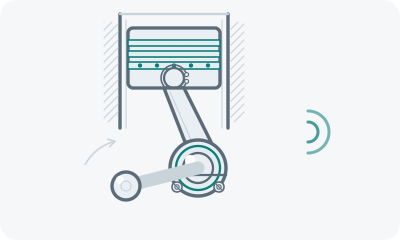
Main bearings are the plain bearings the crankshaft rests on inside the block. They hold the shaft along its whole length and take the load from every cylinder at once. When their clearance grows, the engine starts producing a low, heavy knock that experienced mechanics recognise almost unfailingly. Here are its signs, the symptoms that come with it, and why this fault calls for stopping immediately rather than watching.
What it sounds like
Main bearing knock is dull, low and heavy, as though someone were striking metal from inside through a cushion. It comes from the bottom of the engine, from the sump side, and carries well into the body. The markers:
- Reaction to a sharp throttle. Open the throttle sharply at idle and the knock answers clearly as the revs rise and fall.
- Audible when warm. After warm-up the oil thins, the clearance works more freely, and the sound usually gets worse rather than better.
- Vibration. Often accompanied by a perceptible shake that was not there before.
- Oil pressure. The light flickers or stays on at idle; a gauge needle sags.
The dividing line from the neighbouring fault is simple: big-end bearings sound sharper and come from the middle of the block. Their portrait is in signs of big-end bearing knock, and the full catalogue of engine sounds is on the symptom page knocking in the engine.
The accompanying symptoms
Main bearings rarely go alone. A characteristic picture usually forms around the knock:
- Falling oil pressure — the first and the main one; its signs are in signs of low oil pressure.
- Metallic particles on the sump plug magnet and in the filter.
- Loss of power and rising fuel consumption — the shaft turns against increased friction.
- A hunting idle and vibration in every regime.
- The oil heating quickly during ordinary driving.
A separate nuance: not every loud noise from the engine bay is bearings. Whistles and whines do not belong here at all.
How it is checked
| Check | What it gives |
|---|---|
| Stethoscope along the bottom of the block | The point of maximum volume near the sump |
| Oil pressure with a mechanical gauge | Confirms the loss of the oil wedge |
| Cutting cylinders one at a time | Mains barely react, big ends weaken |
| Inspecting the magnet and the filter | Metal dust and swarf |
| Sump off, clearances measured | The final diagnosis |
A diagnostic scan gives little here: oil pressure codes only point at the problem indirectly. It is decided mechanically — by ear, by gauge and by disassembly.
What follows
The answer to “how much further can I drive” is: not at all. A spun main bearing scores the journal and in a bad case seizes the engine on the move, which is no longer only a question of money. The correct order is: switch off, do not restart, call a tow truck — the wider list of sounds that mean stopping is in noises that mean stop driving now, and where the line runs in can you drive with engine knock.
It helps to understand the scope of work. Main bearings are replaced with the engine out, or at minimum the sump and the crankshaft removed, and if the journals are already scored the shaft is ground to an undersize or replaced. So the quote is drawn up after the strip-down, and any figure named over the phone before that is a very rough guide.
Two questions worth asking when it comes to that. Whether the journals will be measured with a micrometer rather than judged by eye — new shells on a damaged journal do not last. And whether the cause was found: more than half of spun bearings start with oil starvation rather than mileage, so a blocked pick-up screen, a worn pump or a stretched oil interval must be found or the rebuild repeats.
Prevention here is dull but effective: keep to the oil change intervals with an allowance for town conditions and dust, watch the level, and do not ignore the first flickers of the pressure light.
If the knock appeared recently and you are not sure which part of the engine it comes from, record a short fragment at idle and on a throttle blip in the Pro-Stuk app. It compares the sound with your answers about the regime and shows the likely causes with percentages — enough to decide between driving yourself and calling a tow truck straight away.
