

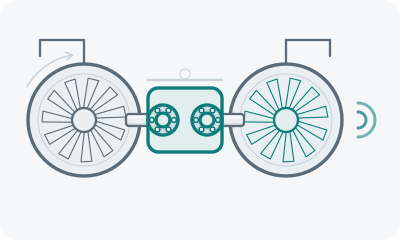
A turbocharger is a wheel spun by exhaust gas to tens of thousands of revolutions a minute, so it always makes a sound. The question is not whether the turbo whistles but whether its voice has changed. It is the trend — louder, a new note, a howl or a grinding sound added — that separates normal from a developing fault. Here is how to judge your own case without dismantling anything.
When the whistle is normal
The standard sound of boost is an even rising whistle under acceleration that goes up and down with the pressure. It appears under load, fades as you lift off and is practically inaudible at warm idle. On some engines a short hiss from the bypass valve as the pedal is released joins it — that is standard too.
The warning signs look different:
- the whistle has turned into a siren or howl, the pitch higher and harsher;
- grinding or a metallic rustle has appeared — the wheel may be touching the housing;
- the sound is now audible at idle, with no load;
- the whistle comes with a loss of pull, bluish smoke or growing oil consumption.
What is checked first
The good news: a large share of “whistling turbos” turn out to be a leak in the intake tract, and the repair costs very little.
- Inspect the hoses and clamps from the intercooler to the throttle: cracks, chafing, loose joints.
- The state of the air filter. A blocked filter creates vacuum and changes the intake sound; at the same time check whether the housing is drawing unfiltered air.
- Turbo shaft play — axial and radial, by hand with the hose removed.
- Traces of oil in the intercooler and hoses: an oily film inside indicates worn seals.
- Boost pressure readings on a scan tool compared with the target value.
A separate fork is back pressure in the exhaust: a blocked catalytic converter changes both the pull and the turbo’s voice. How that shows itself is covered in signs of a blocked catalytic converter.
Similar sounds: how to separate them
| Source | When it is heard | Tied to |
|---|---|---|
| Turbo, boost | Acceleration under load | Boost pressure |
| Drive belt | Idle, cold start, after a wash | Engine speed |
| Idler bearing | Constantly, even tone | Revs, independent of load |
| Boost leak | Acceleration, with loss of pull | Load; the whistle is local |
| Manifold gasket | Acceleration and cold start | A hiss and ticking, not a clean whistle |
The last row is commoner than people think: a leak through a poor manifold joint gives a hiss resembling a whistle, but with characteristic ticking when cold. The breakdown is in burnt exhaust manifold gasket signs. And if the pitch changes with road speed rather than load, the source is not in the engine bay at all; the general map of those sounds is on the symptom page belt squeal, with the belt case itself in a squeal: the belt or an idler bearing.
How the repair is decided
The range of outcomes here is enormous, which is exactly why the causes must not be confused. Before agreeing to have the turbo removed, ask for the intake to be checked for leaks and the belt inspected. That is cheap and closes a fair share of cases. What decides the work after that is two numbers: the boost pressure against the target on a scan tool, and the shaft play measured rather than guessed at.
Two things mechanics do not always say. If the turbo is genuinely worn, the oil feed and drain lines go with it — a new cartridge fed through a coked line fails the same way. And the intercooler is flushed of the oil that has collected in it, otherwise the fresh unit swallows it back on the first hard climb. The van-specific version of all this is in turbo whistle on diesel vans.
The life of the turbo itself depends most on oil and on habits. The shaft bearings are lubricated under pressure, so dirty or worn-out oil kills the unit faster than any mileage. Switching the engine off straight after a motorway run also does damage, when the red-hot shaft is left without circulation, as does driving with a blocked air filter. A calm minute at idle before switching off after a hard run costs nothing and noticeably extends the service life.
If the turbo’s voice has changed and you are not ready to say by ear how much, record two clips in the Pro-Stuk app: acceleration under load and warm idle. The app compares them and shows the likely causes with percentages — so the conversation at the workshop starts not with a general “it whistles” but with a specific operating condition.
