

A blocked catalytic converter rarely announces itself with one vivid symptom. Far more often it chokes the engine bit by bit over months: the car pulls more lazily, climbs get harder, consumption rises — and the driver gets used to the new character, blaming it on age. Here is how to recognise a clogged converter, how it differs from other causes of lost power, and how the repair is decided.
What happens inside
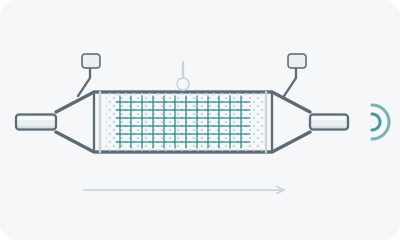
A catalytic converter is a ceramic block with thousands of thin channels coated with precious metals. All the exhaust gases pass through that honeycomb, and on the hot surface the remaining fuel and harmful compounds are burnt off. While the channels are clean, the resistance to flow is small and the engine does not notice it.
Problems begin when extra fuel or oil keeps reaching the exhaust: a rich mixture from faulty injectors, misfires, oil consumption past worn valve stem seals. The unburnt residue settles on the channel walls and cokes, and under severe overheating the ceramic partly melts. The passage narrows, the exhaust gases are squeezed — and the engine starts working against a cushion, pushing spent gases into a blocked system instead of delivering power to the wheels.
How it feels from the driver’s seat
The typical picture combines several signs at once:
- A flat spot at high revs. Up to 2,500–3,000 rpm the car drives almost normally, but above that it hits an invisible wall: the revs rise lazily and the acceleration dies. The more blocked the converter, the lower the ceiling.
- Heavy acceleration under load. A hill, a full car, an overtake — and the engine clearly will not pull, though on a flat road alone it behaves reasonably.
- Overheating around the exhaust. A burning smell, a darkened or glowing pipe in the section ahead of the converter.
- Hard hot starting and a tendency to stall at idle after a long drive: pressure in the exhaust stops the cylinders scavenging properly.
- Rising fuel consumption with no change in driving style.
- Popping and banging in the exhaust — unburnt mixture igniting in the system. That sound and its relatives are on the symptom page exhaust backfire.
A separate scenario is a metallic rustle or pouring sound under the floor: that is ceramic which has already started breaking up, described in a broken catalytic converter: the sound.
What it gets confused with
| Similar symptom | How it differs from a converter |
|---|---|
| A blocked air filter | Power fades more gently, checked in 15 minutes |
| A weak fuel pump | The flat spots are ragged, the car jerks rather than hitting a smooth ceiling |
| A stretched timing chain | Power falls along with chain noise and camshaft codes — signs of a stretched timing chain |
| A rotten silencer | Power is unaffected, only loudness changes — signs of a rotten silencer |
| A faulty turbocharger | Whistling, smoke, lost boost with a sound exhaust |
An indirect but telling sign is how the car behaves with the converter temporarily bypassed during a diagnosis: if power returns at once, little doubt remains. A more precise assessment comes from measuring exhaust back pressure: a gauge is fitted in place of an oxygen sensor and the pressure is watched as the revs rise.
How the repair is decided
The first step is a diagnostic scan. It shows converter efficiency and mixture codes and, more importantly, hints at the cause — because a converter almost never dies by itself but because of a faulty engine. If oil consumption or misfires are not cured, the new unit repeats the fate of the old one. That is the question to settle before any part is ordered: what killed this one.
The second is what goes in its place. An original converter, an aftermarket one and a universal unit differ in price, in service life and in whether the rear oxygen sensor will accept them, and emissions testing rules differ from country to country — so the decision is not made on money alone. Find out what your inspection requires first.
The third is the oxygen sensors themselves: they live in the exhaust stream that cooked the converter, and a workshop replacing the converter without checking them often ends up back at the same fault code.
Where driving with it is still acceptable is covered in can you drive with a broken catalytic converter.
If power is fading gradually and you are not sure the exhaust is to blame, record the engine and exhaust in the Pro-Stuk app — at idle and with the throttle pressed sharply. The app matches the recording with your description of the symptoms and shows the likely causes with percentages, so you arrive with a ready theory rather than “the car will not go”.
