

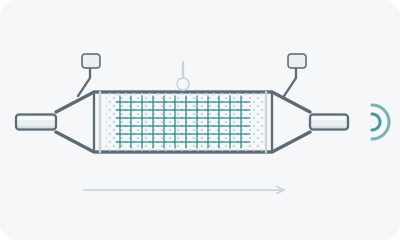
A catalytic converter is a block of ceramic honeycomb in the exhaust system that burns off unburnt fuel. The ceramic is brittle: overheating, an impact, poor fuel or a rich mixture crumble it over time. At first the car simply rustles when you blip the throttle, then it starts choking under acceleration. The question “can I still drive” is not rhetorical here — the answer depends on which stage you are at.
What is actually happening inside
The failure goes in two steps, and they are dangerous in different ways. First the honeycomb cracks and part of the ceramic turns into debris that moves freely inside the housing — the rustling stage. The exhaust is still open, the engine runs almost normally, and what is lost is mainly the emissions function.
The second step is sintering. The remaining fragments fuse into a plug and the exhaust tract stops passing gas properly. The engine has to push exhaust gases through a blockage: power drops, exhaust temperature rises, the exhaust valves suffer, and on some engines the debris finds its way back into the cylinders and scores them. It is the second stage that makes driving genuinely risky.
The transition is not always gradual: sintering accelerates with overheating, and the blockage itself causes the overheating. One long run at high revs is enough to turn a rustling converter into a solid plug. So “it still drives, so I still drive” works worse here than with most other components.
When you can drive on and when you cannot
| Sign | Drive to the workshop | Do not drive |
|---|---|---|
| Ceramic rustle | Present, power unchanged | — |
| Acceleration | Normal or slightly flat | The engine hits a ceiling in revs |
| Idle | Steady | Wanders, stalls |
| Smell and heat | None | Sharp smell, heat from the floor |
| Instruments | Check engine may be on | Coolant temperature rising |
| What to do | Drive calmly, book within days | Tow truck |
With a sintered converter a tow across town is cheaper than the consequences of one long drive on a choked engine.
Making sure it really is the converter
Three checks you can do. First, by ear: tap the converter housing with your palm on a cold car. Distinct pouring inside means the honeycomb is broken. Second, by feel at the wheel: if the car accelerates confidently up to a certain speed and then hits what feels like an invisible wall, that is the classic picture of a blocked exhaust. Third, a diagnostic scan: converter efficiency and rear oxygen sensor codes give extra confirmation.
Do not confuse the ceramic rustle with heat shield rattle or a loose undertray — the sound is similar and the cost differs by an order of magnitude. The full set of noises coming from underneath is on the symptom page rattling under the car, and the sound portrait in a broken catalytic converter: the sound.
How the repair is decided
Two questions decide it, and neither is about the noise.
The first is why the converter died. Misfires, a leaking injector or a rich mixture that cooked the ceramic will cook the replacement just the same. A workshop that quotes a converter without reading the fuel trims and misfire counters is selling you the same repair twice; ask what the scan showed before agreeing to the part.
The second is what goes in its place and what your local rules require. An original part, an aftermarket converter and a universal unit welded in differ in price, in service life and in whether the rear oxygen sensor will accept them — and emissions testing rules differ from country to country, so the decision is not made on money alone. Find out what your inspection requires before choosing.
The general logic of questions like this is always the same: while a part makes noise but does not stop the car driving, you have weeks; as soon as it starts affecting how the car behaves, the count is in days.
If the rustle has just appeared and you want to know whether that is what it is, record the sound in the Pro-Stuk app with the throttle blipped, and repeat the recording after a short drive. The app matches the recordings with your answers and shows the likely causes with percentages — along with a hint as to whether it is urgent or you can calmly book a day this week.
