

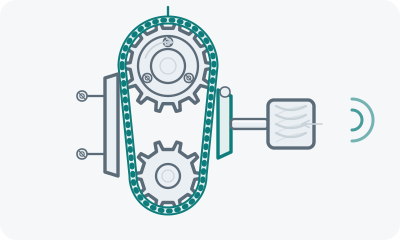
The timing chain synchronises the crankshaft and the camshafts — that is, it keeps the pistons and the valves in agreement about who occupies the cylinder volume and when. When the chain breaks or jumps the sprocket teeth, that agreement vanishes instantly. What follows is decided by the design of the particular engine, and the spread of consequences runs from “we changed the chain” to “it is easier to look for a used engine”.
What happens in the first second
The crankshaft keeps turning under its own inertia; the camshafts stop or rotate to a random position. Some valves stay open while the pistons keep travelling upwards. If the geometry of the combustion chamber allows them to meet, the valves are bent — usually several at once, sometimes with damage to the valve guides, the pistons and the cylinder head.
A separate scenario is a jump of one or two teeth without a break. It is gentler: the timing shifts, the engine starts misfiring and losing power, the check engine light comes on, but a piston does not always meet a valve. Much depends on the driver’s reaction — switching off at once, or trying to “nurse it home”.
The difference between engines comes down to one parameter: whether the piston crowns have deep enough reliefs for the valve heads. Engines where those reliefs give sufficient clearance are called non-interference designs — for them a break means a tow and a new timing drive. But the pursuit of compression ratio and efficiency has made non-interference designs a rarity: on the vast majority of modern petrol and diesel engines the consequences of a break are mechanical.
Three scenarios by severity
| Scenario | What happens | What the repair involves |
|---|---|---|
| A jump of one or two teeth | The engine misfires, loses power, camshaft faults; switched off in time | Chain replaced as a kit |
| Break on a non-interference engine | The engine stalls, the starter spins easily, no compression | New timing drive, sometimes head inspection |
| Break on an interference engine | Valves bend, pistons and head suffer | Cylinder head rebuild or a full engine rebuild |
The gap between prevention and consequences is roughly an order of magnitude, whatever the local labour rates.
Why a break almost always gives warning
A chain rarely snaps out of nowhere on a healthy engine. It is usually preceded by weeks or months of symptoms: the lengthened chain sags, the tensioner extends to its limit, the sprockets wear. To the ear that appears as rattling or metallic rustling at the front of the engine, loudest in the first seconds after a cold start while there is no oil pressure in the tensioner. Then camshaft position faults, an uneven idle and a loss of power join in.
The stage that is especially deceptive is when the cold-start noise lasts a few seconds and goes away: it is easy to write off as “that is how the engine wakes up”. The full cold-start sound picture is on the symptom page engine knock when cold, and the sound portrait of a stretched chain in what a stretched timing chain sounds like.
What to do if it has already happened
The order of actions is short and strict. Switch off as soon as the engine loses power and an unusual clattering appears. Do not try to restart: every turn of the starter adds damage. Call a tow truck. Do not tow the car on a rope in gear — that is the same as turning the engine on the starter.
At the workshop the first steps are a compression test cylinder by cylinder and an assessment of the timing drive. The result shows whether you got away with a jump or the head has to come off. Either way it makes sense to replace the whole drive rather than just the chain: worn sprockets and a tired tensioner kill a new chain within a few thousand kilometres.
One more thing workshops do not always volunteer: while the front of the engine is open, the front crankshaft seal and, on many designs, the water pump are reachable at no extra labour. Asking about them before the job starts is cheaper than asking about them a year later.
The logic of “the noise was there but I got used to it” is the most expensive scenario in car ownership, and it works beyond the engine too — a similar breakdown for the running gear is in driving with dead shock absorbers. What the rattle means while it is still just a rattle is covered in can you drive with a stretched timing chain.
If a rattle has appeared on a cold start and you are not sure whether it is the chain or something harmless, record the first five seconds of the engine running in the Pro-Stuk app. The app matches the recording with your answers and shows the likely causes with percentages — at this stage the difference in the decision is measured in the cost of a whole engine.
