

The short answer: with a stretched timing chain you can usually drive carefully to a workshop, but you cannot “run it out” for weeks and months. A chain gives no honest final warning: between “noisy but driving” and a jump that brings valves and pistons together there may be a single unlucky cold start. Below is how to judge which of the two situations you are closer to, and what delay costs.
What happens inside an engine with a stretched chain
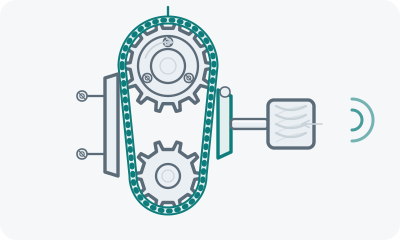
The chain links the crankshaft to the camshafts: while it is taut, the valves open exactly in step with the pistons. A worn chain is longer than designed, the tensioner takes up the slack at the limit of its travel, and the system’s safety margin melts away.
Three scenarios follow, in increasing severity:
- The timing drifts — the engine loses power, misfires, and the check engine light comes on with camshaft correlation codes (P0016/P0017). You can still drive, but the mechanism is already working outside its design range.
- The chain jumps one or two teeth on a sprocket — synchronisation shifts in a single step. The engine stalls or barely runs.
- A jump of several teeth, or a break — on most modern interference engines, where the valve and piston paths cross, the pistons strike the open valves and bend them.
Unlike a belt, a chain rarely breaks — the typical failure is a jump. And it most often happens at the moment of a cold start: oil pressure has not built up, the tensioner is not working at full force, and the starter turns the engine in jerks.
There is a side process that gets mentioned less often. A slack chain whips the plastic guides and tensioner rails and gradually destroys them: the debris goes into the sump and can block the oil pick-up screen. Then oil starvation for the whole engine joins the timing problem — another argument against stretching the life of a worn chain over months.
When driving yourself is acceptable
The risk is moderate if the picture is limited to early signs:
- the rattle is heard only for a few seconds after a cold start, after which the engine runs evenly;
- there are no camshaft correlation codes, idle is steady and there are no foreign noises on a warm engine — if there is noise at idle too, compare it with the symptom page knocking in the engine;
- power and fuel consumption are unchanged.
In that state you can usually drive to a workshop calmly and even use the car briefly in a gentle regime — but with a diagnostic booked, not with a hope that it goes away. The full list of signs by stage is in what a stretched timing chain sounds like, and the listening method in checking timing chain tension by ear.
It helps to fix a reference point: how many seconds the engine is noisy after a cold start today. If in a week or two the sound lasts noticeably longer, or appears on a warm engine, the deterioration is fast and there is less time left than it seemed. The check itself is cheap: a diagnostic scan reading the camshaft correlation angles often settles the “chain or not” question in half an hour.
When it is better not to get behind the wheel
A tow truck is cheaper than a rebuild. It is justified if any one of these is present:
- the rumble or clattering does not go away after warm-up and is audible constantly;
- the check engine light is on with P0016/P0017/P0008, the engine misfires and power is noticeably down;
- starting is laboured: the starter turns for longer than usual and the engine does not catch straight away;
- the engine stalled and will not restart after a metallic clatter — the classic picture of a jump that has already happened; turning the starter further only increases the bill.
That last case has a rule of its own: do not keep trying to start it. If the chain has jumped, every turn of the starter means fresh impacts of pistons on open valves. Damage from the jump itself may be limited to a couple of valves, while persistent starting attempts add guides, pistons and sometimes connecting rods to the estimate.
The cost of delay: the scenarios
| Scenario | What it takes |
|---|---|
| Chain replaced in time | Timing kit plus labour |
| Jump without valve contact | Timing kit, timing marks checked, diagnosis |
| Jump with bent valves | Head work: valves, guides, gaskets, plus the timing kit |
| Severe damage (pistons, rods) | Rebuild or a replacement engine |
The absolute figures differ hugely between engines, because the labour varies several-fold and part prices depend on the choice between original and aftermarket. But the ratio between the rows is the same for any car: each scenario costs several times the one above it.
Two things are worth insisting on when the work is quoted. First, the complete kit — chain, tensioner, guides and sprockets: fitting a new chain onto worn guides is a guaranteed return to the same job, and the access has already been paid for. Second, on engines where the water pump or the sump gasket sits behind the same cover, ask whether they are included for the same reason.
Reducing the risk if you do have to drive
If the replacement is booked but you have a few days to cover:
- cut the number of cold starts — they are the most dangerous for a worn chain; one trip with several stops is better than five short ones;
- if the car has stop-start, switch it off: every automatic restart is another jerk for a slack chain;
- check the oil level and top it up: the tensioner runs on oil pressure;
- after starting, let the engine run for 30–60 seconds without load — the first seconds are the most vulnerable;
- avoid sharp throttle blips, full-throttle starts and high revs;
- if new noises or fault codes appear, stop and call a tow truck.
These are risk-reduction measures, not a way to postpone the repair: a worn chain does not recover and does not get cheaper with time.
If you are not sure it is the chain making the noise, record the engine in the Pro-Stuk app: it matches the recording with your answers to a few questions and shows the likely causes with an urgency rating. That makes it easier to decide between driving to the workshop and calling a tow truck straight away.
