

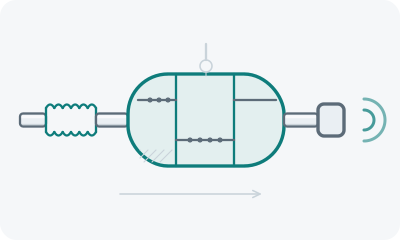
The exhaust manifold collects gases from the cylinders and joins the cylinder head through a gasket working in hard conditions: temperature swings of hundreds of degrees, vibration, constant cycles of expansion and contraction. When the gasket burns through, a gap appears at the joint and exhaust gases escape straight into the engine bay. The sound is so recognisable that the diagnosis is often made in the first minute — if you know what to listen for.
What it sounds like
The classic picture is rapid dry ticking or chattering from under the bonnet, synchronous with engine revs and loudest in the first minutes after a cold start. Many describe it as “the valves have started knocking” — the resemblance is real, and that is the main cause of mistakes.
The markers that give the manifold away:
- A sharp reduction after warm-up. The metal has expanded, the gap has nearly closed, the sound has faded or disappeared.
- Growth under load. Blip the throttle and the ticking becomes clearer, with hissing added.
- Location. The sound comes from the exhaust side rather than from the rocker cover; it is heard better from outside, by the wheel arch, than from above.
- Accompanying signs. A smell of exhaust in the bay and sometimes in the cabin, and a perceptible flow of hot air at the joint.
The general breakdown of foreign sounds tied to idle speed is on the symptom page engine ticking, and the lifter version in hydraulic lifters ticking when cold.
What is looked at during an inspection
The theory can be confirmed almost without tools, on a cold engine.
- Black soot deposits around the manifold-to-head joint or on the heat shield — the most reliable visible sign.
- Soot in a fan shape spreading from one particular port: it shows which passage is leaking.
- The state of the studs and nuts: a snapped or loose stud almost always accompanies a burnt gasket.
- A check with the engine running: a gloved hand near the joint feels a pulsing jet of hot gas.
- Fuel trim data: air drawn in through the exhaust distorts the oxygen sensor signal and the mixture can go rich.
What it gets confused with
| Source | Character | What separates it |
|---|---|---|
| Manifold gasket | Ticking with hissing | Louder when cold, soot at the joint |
| Hydraulic lifters | Ticking from above | From under the rocker cover, no soot |
| Heat shield | Rattling, ringing | Reacts to bumps and vibration |
| A cracked manifold | The same ticking | Visible split, the sound does not go after warm-up |
| Catalytic converter | Rattles, chokes power | The sound comes from the canister under the floor |
The last row is a frequent neighbour: exhaust faults often come in pairs. A pouring rustle from the converter is covered in a broken catalytic converter: the sound, and rhythmic popping from the engine itself in signs of a burnt valve by ear.
How the repair is decided
The repair is comparatively cheap if it is taken on in time. The main difficulty is seized and snapped studs: drilling them out and restoring the threads sometimes costs more than the gasket itself. That is the question worth asking before the job — what happens if a stud snaps, and whether the workshop can repair the thread in place or the head has to come off.
Two more things. Whether the manifold’s mating face will be checked for flatness: a manifold that has warped will burn a new gasket within months, and a workshop that skips that step is selling the job twice. And whether the nuts will be torqued in the correct sequence — manifold fasteners are tightened from the centre outwards in stages, and a gasket clamped unevenly leaks from the first cold start.
There is also an indirect cost. Part of the exhaust escapes before the oxygen sensor, and during valve overlap outside air is drawn into the system. The sensor sees extra oxygen, the ECU decides the mixture is lean and adds fuel — consumption rises and the converter works outside its design range. So a jump of a litre or two in consumption alongside cold-start ticking is not a coincidence but the same cause.
Do not put it off, for two reasons. A jet of red-hot gas works like a blowtorch on everything nearby: hoses, wiring, plastic covers. And the gap grows while the studs burn further, so a simple gasket change becomes a drilling saga.
If the ticking appears only when cold and you are not sure it is not the valves, record the first thirty seconds after a cold start in the Pro-Stuk app, then the same fragment on a warm engine. The app compares the recordings and shows the likely causes with percentages — this fault is recognised especially well by the cold-versus-hot difference.
