

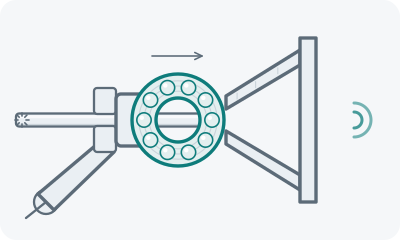
The release bearing is the small part through which the clutch pedal acts on the pressure plate: pressing the pedal pushes it against the rotating diaphragm fingers and separates the engine from the gearbox. It only works at the moment of disengagement, and that is what makes it convenient to diagnose: the sound of a worn release bearing is rigidly tied to the pedal, so it is easier to identify than most noises on a car. Below: what the wear sounds like, how to check everything with the pedal in a minute, what it gets confused with and how the repair is decided.
What a worn release bearing sounds like
The classic picture: at idle with the pedal up it is quiet; press the clutch and a rustle, a shuffling or an even hum appears; release it and the sound goes. That is how a bearing that has lost its grease or worn its raceways behaves: under the load of disengagement the defect shows, without it the bearing is silent.
As the wear progresses the sound evolves: a light rustle, then a clear hum, then rattling and grinding at every press. Sometimes the pedal follows: a slight vibration underfoot, an uneven effort, and at a late stage crunching when pulling away and gears that are hard to select.
The one-minute pedal test
Start the engine, leave it in neutral and listen in three states. The clutch pedal works as a switch that loads different parts in turn:
| Pedal up (neutral) | Pedal pressed | Likely source |
|---|---|---|
| Quiet | Rustle or hum appears | Release bearing |
| Rustle or noise | Sound disappears | Gearbox input shaft bearing |
| Sound present | Sound unchanged | Engine and its accessories |
The second case is covered in a whine with the clutch pressed and gearbox whine in neutral. The third means looking under the bonnet rather than at the transmission. Repeat the test on a cold and a warm engine — some noises only live in the first minutes after starting.
What the sound gets confused with
Making a mistake is easier than it sounds: plenty of things speak up at idle.
- Hydraulic lifters — the devices that take up valvetrain clearance — tick rapidly when cold, and an inexperienced ear takes that for a rustle from the gearbox area. The difference: ticking follows warm-up and revs and ignores the clutch pedal. The breakdown is in hydraulic lifters ticking when cold and on the symptom page engine ticking.
- The gearbox input shaft bearing — its noise mirrors the release bearing: heard in neutral, gone when the pedal is pressed.
- Accessory idlers and bearings (alternator, belt tensioner) — they rustle constantly regardless of the pedal and follow engine revs.
- Vibration at idle on its own does not point at the release bearing — it has its own list of causes, from engine mounts to ignition; see the symptom page vibration at idle.
- A dual-mass flywheel clatters at start-up and shutdown rather than with the pedal — what a worn dual-mass flywheel sounds like.
The rule is simple: before thinking about the release bearing, make sure the sound is controlled by the clutch pedal. If the pedal does not affect it, the release bearing is not involved.
Why release bearings wear early
Their life is measured not in kilometres but in hours under load — that is, the time the clutch pedal spends pressed. Hence the main accelerators:
- resting a foot on the pedal while driving: even light contact makes the bearing work under load the whole way;
- sitting at traffic lights with the clutch pressed instead of in neutral — in a town cycle that adds up to tens of hours of extra work;
- traffic in itself: a thousand town kilometres load the release bearing more than five thousand on a motorway.
A separate story is the hydraulic release bearing (a concentric slave cylinder), where the bearing and the cylinder are one unit inside the bellhousing. It dies not only by noise but by leaking: clutch fluid escapes and the pedal softens or goes to the floor. That unit can only be replaced with the gearbox out, so the “replace as a kit” rule matters even more for it.
Can you keep driving
A noisy release bearing is not a reason to stop at the roadside: cars run with a light rustle for a long time. But two risks are worth understanding. First, suddenness: a collapsed bearing can seize, and then the clutch stops disengaging — you have to change gear without it and start on the starter motor, which is only good for reaching a workshop. Second, collateral damage: a broken release bearing presses unevenly on the pressure plate fingers and wears them, adding the pressure plate to the bill.
A simple habit reduces the load until the replacement: do not rest your foot on the clutch pedal while driving and do not sit at lights with the clutch pressed.
How the repair is decided
The bearing itself is an inexpensive part, but it can only be reached with the gearbox off — so the labour forms the bill. That single fact drives everything: a release bearing is almost never replaced on its own, only as part of a clutch kit.
While the box is out, the same access covers the clutch disc, the pressure plate, the rear main seal and the gearbox input shaft seal. Ask which of those are in the quote — a leaking rear main seal refitted behind a new clutch is the classic reason the job is done twice. On dual-mass flywheel cars, the flywheel’s free play is measured while everything is apart, and the measurement, not a guess, is what decides whether it stays.
Not sure whether the sound reacts to the pedal, or whether something else is making noise? Record the engine in the Pro-Stuk app — first in neutral, then with the pedal pressed. The app matches the recordings with your answers and shows the likely sources with an urgency rating.
