

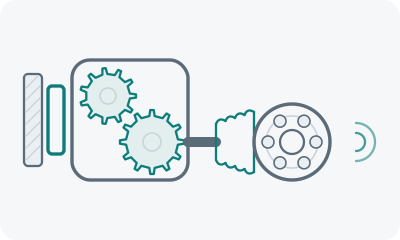
The neutral throttle test is the simplest of diagnostic procedures and at the same time one of the most useful. The car stands still, the gearbox is in neutral, you raise the revs smoothly and listen to what changes. The point is that in this state only the engine and everything it drives are working: the wheels, the suspension and the transmission are out of the equation. One movement of the pedal halves the set of possible causes.
How to run it
The sequence is short, but every step matters:
- Warm the engine to operating temperature — on a cold engine there are too many “normal” sounds.
- Put the car on the handbrake, the gearbox in neutral or park, and chock the wheels.
- Open the bonnet and stand to one side, by a wing. A helper works the pedal.
- Raise the revs smoothly to 2000–2500, hold for two seconds and return just as smoothly. Repeat three or four times.
- Separately, do one sharp lift-off from 3000 — the moment of lift-off is informative in itself.
- Repeat the cycle with the air conditioning on: some sounds only appear under the compressor’s load.
What you listen for is behaviour, not loudness. The key questions: does the sound rise with the revs or live its own life? Does its pitch change or only its volume? Does it appear on the lift-off or on the way up?
What the result shows
| How the sound behaves | Likely source |
|---|---|
| Squeal rising with the revs | Drive belt, idler, tensioner |
| Hum or whine tied to the revs | Alternator bearing, water pump |
| Rattle at the moment of lift-off | Stretched timing chain, tensioner |
| Ticking that fades as it warms | Hydraulic lifters, valve clearances |
| Popping in the exhaust on lift-off | Mixture, ignition, an air leak |
| Nothing changes | The source is not connected with the engine |
The last row is the most valuable result of the test. If the sound cannot be reproduced in neutral at all, there is no point looking under the bonnet: the cause is in the running gear, the brakes or the tyres. Brake grinding, for example, only appears with the pedal pressed on the move and is silent on a stationary car — the signs of that group are covered in telling brake pad wear by ear.
The details that change the picture
A sharp lift-off is a small separate test. At that moment the timing chain tension falls, the accessories are unloaded, and the pressure in the intake and exhaust changes. A short metallic rattle on lift-off points at the timing drive, dull popping in the silencer at the air-fuel mixture and ignition; the catalogue of that branch is on the symptom page exhaust backfire, and the chain case in signs of a stretched timing chain.
Switching on the air conditioning engages the compressor — a heavy load on the belt. A squeal that only appears with the a/c almost always means a slipping belt or a worn tensioner rather than a failing compressor — a squeal: the belt or an idler bearing.
One more nuance is where the listener stands. Changing the revs changes the sound of the whole engine bay at once, and standing in one place makes it easy to get the source wrong. Walk around the car: from the front, from the left wing, from the right, and compare.
What to do with the result
The test does not make a diagnosis, it narrows the search. Afterwards you have an answer to the main question — engine or not — and a description of how the sound behaves. That is enough for the conversation at the workshop to start with specifics rather than “something is making a noise”. How to phrase your observations so a mechanic understands them first time is covered in how to describe a car noise to a mechanic. If the sound did not reproduce in neutral, the next step is checking the running gear in the order set out in suspension diagnosis by ear: the full checklist.
What the test changes at the workshop
The practical value is in what you no longer pay to have found. A diagnosis that starts from “it is not the engine” skips the stethoscope session under the bonnet entirely; one that starts from “the squeal grows with the a/c on” goes straight to the belt and the tensioner. Both save an hour of labour, and the observation costs nothing.
Two things worth mentioning to the mechanic afterwards. Whether the sound followed the revs or the road speed — that single sentence separates the engine from the running gear more reliably than any adjective. And whether it appeared on the way up or on the lift-off, because the lift-off is where the timing drive gives itself away.
The test is convenient to run with the recording on in the Pro-Stuk app: it catches exactly the change of sound with the revs, matches it with your answers and shows the likely causes with percentages — together with a hint about which part to check first.
