

A Haldex coupling is the unit that engages the rear axle on all-wheel drive cars with a transverse engine. In ordinary driving it barely announces itself: it works in the background, engaging the rear axle as needed. So owners usually describe the first signs of trouble not as a breakdown but as an oddity — something crunched during a turn, something jerked while parking. Here is how a struggling coupling sounds, what it is confused with, and what is checked.
How the unit works and why it makes noise
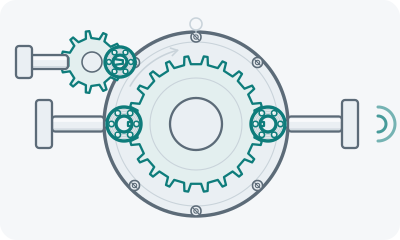
At the heart of a Haldex is a pack of friction plates compressed hydraulically to transmit part of the torque to the rear axle. Electronics control the process, a pump creates the pressure, and one small volume of fluid serves as both the hydraulic medium and the lubricant. Hence the key characteristic: the condition of the fluid directly determines how the unit behaves.
Over time the fluid becomes saturated with wear products from the plates, the filter blocks and the pump loses output. Compression of the pack becomes imprecise: the plates alternately slip and grab with a jerk. It is those jerks the driver hears as a crunch or a crackle during low-speed manoeuvres, when the front and rear axles travel different distances and the speed difference is at its greatest.
The symptoms that identify the coupling
| Sign | When it shows itself |
|---|---|
| Crunching, jerking during a turn | At low speed, wheel on lock |
| Snatching while parking | During back-and-forth manoeuvres |
| All-wheel drive gone | Front axle spins, the rear does not help |
| An AWD warning on the dash | Constantly or intermittently |
| Hum and whine from the rear under power | At speed, rising with revs |
An important detail: the coupling almost never makes noise on a stationary car. If the sound is heard at idle without moving, the transmission is not where to look — the typical causes are covered in an engine knock at idle.
What it is most often confused with
The main candidate for confusion is the outer CV joint. It also clicks during low-speed manoeuvres, and by ear the sounds are similar. Three signs separate them: the CV joint’s sound comes from the front on one particular wheel, it only appears with the wheel noticeably turned and under power, and its clicking is strictly rhythmic with wheel speed. The coupling sounds duller, comes from under the centre of the car and is more often perceived as a jerk than as a chatter. The detailed portrait of the joint is in signs of a worn outer CV joint, with the general catalogue of manoeuvring sounds on the symptom page clicking when steering and the separation method in clicking: CV joint or brakes.
The second candidate is the rear differential and the propshaft: the centre bearing and universal joints give hum and vibration, but they are tied to speed rather than to steering angle — signs of a worn propshaft centre bearing. The third is the brakes: a seized caliper can produce a grinding sound during a turn that is easily blamed on the transmission. The fourth is a difference in wear or size between the tyres on the two axles. All-wheel drive with a coupling is sensitive to a permanent mismatch in wheel speeds, and mismatched tyres can both provoke the jerking and accelerate wear of the friction plates.
Diagnosis and how the repair is decided
The check starts by reading fault codes: the coupling’s electronics record pump failures, sensor faults and entries into protection mode. Next the fluid is inspected — its colour and smell say more about the state of the friction plates than any external look. Then the unit’s operation is checked on a lift, watching whether the rear axle engages.
The criterion for the work follows from that order, and it is almost always the fluid first. Scheduled servicing of the coupling — fluid and filter — costs a fraction of restoring it, and this is the case where saving on consumables almost guarantees a larger bill later. Only if fresh fluid and a clean filter do not restore normal engagement does the pump or the clutch pack come into the conversation.
Two things mechanics do not always say. The filter is a separate part from the fluid and is sometimes quietly skipped — ask whether it is included, because a new fluid pushed through a blocked filter is money wasted. And before blaming the coupling, have the tyres checked for matching size and tread depth across the axles: a mismatch there produces exactly these symptoms on a healthy unit.
If the crunch during turns has appeared recently and it is unclear whether it comes from the front or the rear, record the sound in the Pro-Stuk app during a manoeuvre in an empty car park. The app matches the recording with your answers and shows the likely causes with percentages — which narrows the search to one axle straight away.
