

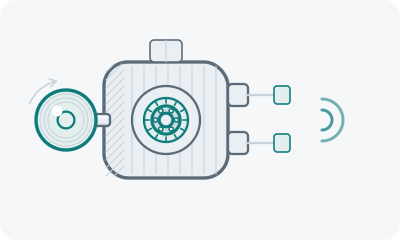
A whine under the bonnet that rises in pitch with engine revs and ignores road speed is almost always one of the accessories. On a Chevrolet Cruze the alternator is the first suspect people name, and often rightly: its shaft bearings work constantly, and on engines with a one-way pulley there is one more wearing element on top. But there are several theories here, and they should be checked in order.
What separates this whine from the others
The key sign is the link to engine revs rather than speed. Stand still and raise the revs to 2,000 — if the sound rises with them, the chassis and the tyres are out of the picture. The second sign is that it comes from the engine bay and is clearly audible with the bonnet open.
The third is character. A bearing usually gives an even howl or hum. Squealing belongs to the belt itself rather than to what it drives. Grinding and rumbling mean the bearing is already breaking up. The whole family of these sounds is covered on the symptom page belt squeal.
What else turns on that belt
| Unit | How it shows | How to check |
|---|---|---|
| Alternator | Even howl, rises with revs | Listen with a stethoscope, check pulley play |
| Alternator one-way pulley | Rattle when lifting off, belt jerking | Checked by hand with the belt off |
| Idler, tensioner | Hum with a metallic edge | Spin it by hand without the belt |
| Water pump | Howl plus coolant traces | Inspect the area for leaks |
| A/C compressor | The sound changes with the climate control | Switch the air conditioning on and off |
| The belt itself | Squeal, especially cold and in damp | Inspect for cracks, check tension |
The most informative test is to remove the belt and run the engine briefly. If the whine disappears, the source is among the units above, and each is then checked by turning it by hand: a bearing gives itself away with roughness and play. If the whine remains, the cause is inside the engine and that is a different conversation. Running the engine without the belt is only acceptable briefly and not on every car — check with a mechanic first, because the water pump usually stops along with the belt.
Why alternator bearings wear out
There are several reasons and they add up. An over-tightened belt puts extra radial load on the bearing — a classic mistake after a do-it-yourself replacement. A worn one-way pulley makes the alternator work in jerks. Dust and water from the road get into the housing through the ventilation openings. And finally age simply plays its part: a hundred thousand kilometres of continuous rotation at high speed is honest wear.
How the repair is decided
The first fork is rebuild or replace. On many alternators new bearings are a legitimate and much cheaper option; the decision is made once the unit is open and the windings, the regulator and the brushes can be assessed. The second fork is the one-way pulley: it is a wearing part in its own right, it produces very similar noise, and it can often be replaced on its own without touching the alternator at all — worth asking about explicitly.
One practical rule: if the belt and idlers have already covered a hundred thousand kilometres, replace them along with the alternator work. The access is the same, and a second visit for the same reason in six months costs more than the parts do now.
To avoid checking everything at random, record the sound with the Pro-Stuk app at the open bonnet: first at idle, then with the revs raised smoothly. The app matches the recordings with your answers to a few questions and shows the likely causes with percentages — so it becomes clear which unit to start with.
