

The Haval Jolion is a mass-market compact crossover, and the complaint about a knock at the front sounds much the same as on any other car in its class: a dry click or short thump over small bumps, slab joints and speed humps, with silence on smooth tarmac. Below is a sensible order of checks: from the most common and cheapest to the rarer and more expensive. That sequence saves both time and money, because in roughly half the cases there is no need to go past the first item.
Start here: the anti-roll bar links
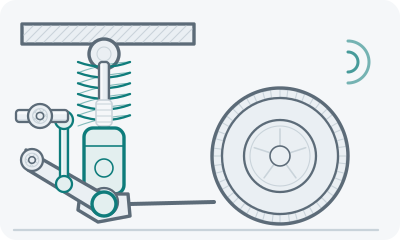
An anti-roll bar link is a thin rod with two joints connecting the anti-roll bar to the strut. Its joints are small and take very frequent alternating loads, so it is the first thing to wear on almost every front-wheel-drive crossover, whatever the badge.
The characteristic sign is a knock on small, frequent bumps rather than large potholes, and noticeably louder on a cold car. The check is simple: on a lift, or even with the car on the ground, take the rod in your hand and rock it — a healthy one gives no perceptible play and does not click. The second method needs no pit: rock the body over the wheel and listen. The full signs are in signs of worn anti-roll bar links.
The second round: top mounts and bushes
If the links are sound, three things come next.
The strut top mount bearing — the part the strut rotates on with the wheel. Its signature is a click or crunch when steering while parked and at low speed, rather than over bumps — a noisy strut top mount bearing.
Control arm bushes — the rubber-to-metal sleeves that damp vibration. Worn ones give a dull knock over larger bumps and vague steering in ruts. Tears in the rubber are visible; hidden wear is checked with a pry bar — signs of worn suspension bushes.
The dampers and their mountings. A knock on bottoming out, oil traces on the body, the car rocking for more than one cycle after being pushed.
The ball joints are checked separately — not because they often fail at this mileage, but because they are the only part on the list whose failure is genuinely dangerous: signs of a worn ball joint.
What knocks outside the suspension
| Source | When it is heard | How to tell |
|---|---|---|
| Outer CV joint | Rattling in a tight turn under power | Silent in a straight line, not over bumps |
| Track rod ends | Knock through the steering on fine ripples | Play when rocking the wheel horizontally |
| Heat shield | Rattle at particular revs | Follows revs, not the road |
| Luggage, the jack | Knock over any bump | Gone once unloaded |
| Cabin plastics, seals | Creaks in the cold | Changes when you press the trim |
The first row is the one most often confused with the suspension: CV joint clicks resemble a joint cracking and are clearly heard during a U-turn. Their sound portrait is in signs of a worn outer CV joint, and the general catalogue of road knocks is on the symptom page knocking in the suspension.
What to ask for at the workshop
While the warranty runs, start with the dealer and have the complaint recorded in writing. Ask for the play to be shown to you on the lift rather than described — a mechanic loading each joint with a pry bar can point at exactly what moves, and that conversation prevents a parts list built on guesswork.
Ask, too, which of the work needs an alignment afterwards: links do not, arms and struts do, and knowing that in advance keeps the quote honest. The general diagnostic logic for cars in this segment is in Chinese SUVs: common noises on Chery, Haval and Geely.
It helps to arrive with a description rather than the single word “knocking”: the speed, the type of bump, cold or warm car, a single knock or a chatter. Recording the sound and breaking it down by those conditions is what the Pro-Stuk app does — it matches the recording with your answers to short questions and shows the likely causes with percentages, so the conversation at the workshop starts from specifics.
