

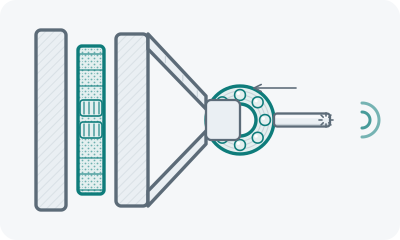
The complaint has a very characteristic sound to it: as the clutch pedal goes down, a dry click or knock comes from under the bonnet or from under the floor, sometimes twice — once on the way down and once on the way back. The car drives normally, the gears select, the clutch holds. On a Ford Focus with a manual gearbox this is one of the most recognisable situations, and in most cases what lies behind it is the clutch release mechanism rather than the clutch itself.
How the mechanism works and what wears in it
To disengage the clutch, the effort from the pedal is passed to the fork — a lever that presses on the release bearing, which in turn pushes the fingers of the pressure plate. The fork pivots on a ball stud or plastic seat inside the bellhousing and works under noticeable load every time the driver pulls away.
Three places wear here. The first is the fork’s pivot point: the plastic or metal seat wears, play appears, and the fork jumps at each stroke. The second is where the fork contacts the release bearing: a clearance appears there too. The third is the release bearing itself, which can start making noise with the pedal pressed — whine with the clutch pressed.
Telling it from other sounds
| Sign | Clutch release mechanism | Other parts |
|---|---|---|
| Link to the pedal | Strict: only when working the pedal | None |
| Dependence on speed | None | Running gear hum and knock rise with speed |
| Dependence on the road | None | The suspension answers bumps |
| Sound with the pedal pressed | Rustling — the release bearing | — |
| In neutral with the pedal up | Hum — the input shaft bearing | — |
A simple home test: start the car, put it in neutral and slowly, without any sharpness, press the clutch to the floor and release it. A click at the end of the travel and at the start of the return is the handwriting of a worn fork pivot. The general breakdown of stray sounds from below is on the symptom page rattling under the car, and the related case of a knock as the pedal comes back up in a knock when releasing the clutch.
What a workshop does
First the simple things are ruled out: the release mechanism is inspected — on a Focus the clutch can be cable or hydraulic, and in the first case the problem is sometimes solved by adjustment and lubrication, while in the second the master and slave cylinders are checked. Next come the gearbox mountings and the engine mounts: a sagged mount gives a similar knock as the load changes, signs of worn engine mounts.
If all of that is clean, the gearbox comes off. And that is where the main conversation starts: since the access is open, it makes sense to assess the wear of the disc, the pressure plate and the release bearing.
How the repair is decided
The criterion is simple and it is about access, not parts: once the gearbox is off, the labour has already been paid for. Fitting a kit costs more once but less over a couple of years, because removing the gearbox a second time costs the same as the first. So the question to answer before the work is whether the clutch itself has anything left in it.
It helps to give the mechanic the whole picture in advance: when the sound appeared, whether anything changed in the pedal’s behaviour, whether there is a smell of clutch after climbs, and whether the car slips under hard acceleration in a high gear. A knock from the fork pivot does not by itself mean a worn clutch, but if those signs have joined it, the decision about a kit becomes obvious before anything is dismantled — signs of a worn clutch.
Two things mechanics do not always say. If the car has a dual mass flywheel, its condition is assessed with the gearbox off and it is the one item that can double the bill — ask for its free play to be measured rather than judged by eye, signs of a failing dual mass flywheel. And a new clutch wants a gentle first few hundred kilometres to bed in, without towing or hard launches.
It is also worth making sure a different sound is not confusing you: a hum heard on the move and unconnected with the pedal is the running gear or the tyres. How to separate them is in humming: wheel bearing or tyres.
If the knock is still occasional and you want to know whether the gearbox should come off, record it in the Pro-Stuk app while slowly pressing the pedal with the engine running. The app matches the recording with your answers to a few questions and shows the likely causes with percentages — enough to arrive at the mechanic with a specific question.
