

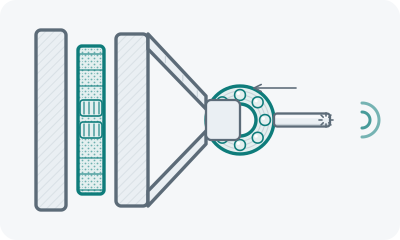
The moment the clutch pedal comes up is the most loaded of the whole journey: torque rises from zero to working level in fractions of a second, and the whole chain from flywheel to wheels takes a jolt. If extra clearance has appeared anywhere in that chain, it is taken up with an impact and the driver hears a knock. Here are the components that knock at that moment, how to tell them apart without dismantling, and how the repair is decided.
Where the knock is born
First in line is the clutch disc’s damper — the set of springs that absorbs the jolts between engine and gearbox. When the springs sag and their windows are hammered out, the disc gains free movement, and when drive is applied there is a short metallic knock.
Next comes the dual-mass flywheel, if fitted: the same job and the same ailment. A worn flywheel knocks when pulling away and adds shake at idle — signs of a failing dual-mass flywheel.
The third group, and in practice the most common, is the engine and gearbox mounts. A torn rubber-to-metal mount lets the engine rock further than intended and the impact travels through the whole body — signs of worn engine mounts. Finally, the driveshaft joints and suspension components — anti-roll bar links, worn bushes — can knock simply by responding to the body’s lurch.
Telling the sources apart
| Source | Where it is heard | Accompanying signs |
|---|---|---|
| Clutch disc damper | From the bellhousing area | Knock when pulling away and on lift-off |
| Dual-mass flywheel | The same place, duller | Shake at idle, judder at shutdown |
| Engine or gearbox mount | Felt in the floor and the gear lever | Knock when blipping the throttle in neutral |
| Driveshaft joints | To the side, nearer the wheel | Crunching in a turn under load |
| Suspension, anti-roll bar links | From below, on one side | The same knock over bumps |
The dividing line is one simple test: blipping the throttle in neutral. If sharply raising and dropping the revs with the car parked produces the same knock, the clutch is not involved — it is not working in that regime at all, and what moves is the engine on its mounts. If the knock appears only when pulling away, the circle narrows to the clutch, the flywheel and the driveshafts. The unit’s condition as a whole is covered in signs of a worn clutch release bearing.
What to check yourself
- Blip the throttle in neutral — separates the mounts from the clutch, takes a minute.
- Pull away without throttle. On a level area, release the pedal at idle. A knock exactly at the bite point points at the damper or the flywheel.
- Release slowly. Repeat three times more slowly. If the knock disappears, it is about how abruptly the torque rises — meaning the play exists but is still small.
- Listen with the pedal down. Check the sounds with the pedal pressed separately: a whine in that position is covered in a whine with the clutch pressed. A thump through the body when pulling away belongs to signs of a worn inner CV joint. The general catalogue of under-bonnet sounds is on the symptom page knocking in the engine.
How the repair is decided
The gap between the cheapest and the dearest item on this list is almost two orders of magnitude, so there is no sense rushing to “it is probably the clutch”. A diagnosis on a lift settles the mounts and the driveshafts in half an hour, and only if they are sound does the conversation move to the gearbox.
Two things worth asking. Whether the mounts were checked under load — with drive applied against the brake while the engine bay is watched — rather than by eye. And, if it does come to the clutch, what else is included while the gearbox is out: the release bearing, the rear main seal and, on a dual-mass flywheel, the measurement that decides whether it stays.
If the knock is still occasional and you are unsure where it comes from, record it in the Pro-Stuk app twice: blipping the throttle in neutral, and pulling away. The app compares the recordings with your answers and shows the likely causes with percentages.
