

The subject of cylinder bore scoring has become firmly attached to Hyundai and Kia engines — so firmly that any stray sound from under the bonnet is reflexively fitted to it by owners of a Solaris, Rio, Sportage or Tucson. The reality is calmer: most knocks have other, far cheaper explanations. But scoring does have its own sound signature, and it is useful to know — if only to understand when it is time to move from listening to measuring.
What scoring is and why it makes noise
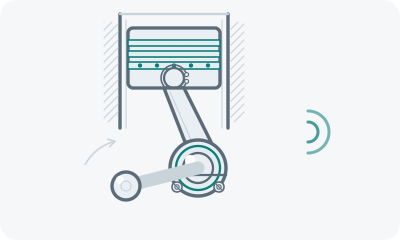
Scoring is damage to the cylinder wall: grooves and torn areas on the surface the piston travels along. Because of them the rings lose their seal, compression falls and oil starts passing into the combustion chamber. The clearance between piston and wall grows, the piston gains freedom to rock as it passes top dead centre — and at that moment the skirt strikes the wall. That produces the sound mechanics call piston slap: dull, muffled, in time with the revs, closer to the bottom of the block.
The causes of the damage vary: abrasive material reaching the cylinder, oil starvation, overheating, prolonged running under detonation, poor fuel, over-long oil change intervals. In practice one factor rarely acts alone — usually several overlap.
The sound portrait
| Sign | Bore scoring | Other common causes |
|---|---|---|
| Timbre | Dull, muffled knock | Ticking, ringing, chatter do not fit |
| Rhythm | In time with revs, even | Injectors click faster and finer |
| Warm-up | Early stage quieter when hot, late stage does not go | Valve clearances nearly always fade |
| Load | More noticeable under load and on acceleration | Accessories usually ignore load |
| Companion signs | Oil consumption, loss of pull, smoke | Accessories and timing drive have none |
The key sign is not the knock itself but the company it keeps. Scoring almost never arrives alone: along with the sound, the oil topped up between changes increases, bluish smoke appears on a sharp throttle after idling, acceleration loses its flexibility, the engine holds its revs less well. A sound with none of those companions far more often turns out to be the chain, the valve train or the accessories. The logic for separating those cases is covered in an engine knock at idle, and the general catalogue of this group of sounds is on the symptom page knocking in the engine, with the full symptom list in signs of cylinder bore scoring.
How scoring is distinguished from similar knocks
The first thing ruled out is the timing drive. A stretched chain gives a rattle and a rustle at start-up and on lift-off rather than an even impact under load; its signs are listed in signs of a stretched timing chain. The second is the valve train: its ticking is bright and high, heard from above at the cylinder head, and usually goes with warm-up. The third is the accessories: if the drive belt is removed and the sound disappears, the piston group has nothing to do with it.
Then the measuring starts. A compression test shows whether one or two cylinders are down. An endoscope through a plug hole lets you see the cylinder wall and tell light marks from deep grooves. It is also useful to work out the real oil consumption: a top-up tied to mileage is a far more honest indicator than impressions. The related model-specific case is in G4FC ticking: normal or bore scoring.
How the decision is made
The gap between a diagnosis and a rebuild is enormous here, and that is exactly why you should neither diagnose yourself from an internet video nor drag it out to the last. The sensible sequence is to record the sound, track the oil consumption over the next thousand kilometres, then have a compression test and an endoscope inspection. Those three steps cost incomparably less than a mistake in either direction.
Two things mechanics do not always say. Oil consumption has to be measured properly to mean anything — the level checked on the same level ground, at the same temperature, with the mileage between checks written down. And ask for the endoscope photographs rather than a verbal verdict: the difference between light honing marks and deep grooves is what decides between watching and opening the engine, and it is visible in a picture.
The first step is convenient with the Pro-Stuk app: record the sound on a cold and a warm engine, note whether it changes under load, and answer the questions about oil top-ups. The app shows the likely causes with percentages and suggests which measurements are worth ordering at a workshop first.
