

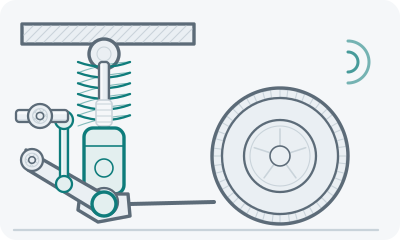
The Volkswagen Polo Sedan and Skoda Rapid use a simple, reliable rear suspension — a semi-independent torsion beam. There are few parts in it and almost nothing to break, and that is exactly why owners often describe a knock at the rear on these cars as mysterious: it knocks, but there seems to be nothing to look at. In practice there are only a few sources, and they are well distinguished by the conditions in which the sound appears. Here they are in order.
What can knock in a rear beam
The beam is attached to the body through two bushes — rubber-metal sleeves that hold its position and damp vibration. That is the first and commonest source of a knock: the rubber cracks with time, loses its springiness, play appears, and the beam starts to speak up over bumps.
The second source is the dampers. A worn rod or a hammered-out top mount gives a dull knock in time with the body’s movement, especially noticeable on undulating surfaces. The third is the bump stops and boots: a destroyed bump stop turns every compression stroke into metal hitting metal. The fourth is the fasteners: bolts, springs that have shifted off their seats, and simply unsecured luggage in the boot, including the jack and the spare wheel.
A wheel bearing sometimes ends up on this list too, but it has a different voice: it does not knock, it hums, and the sound is tied to speed rather than to bumps. The distinction is covered in detail in signs of a worn wheel bearing.
Localising the source
| Conditions | Likely source |
|---|---|
| Small frequent bumps, dull knock | Beam bushes |
| Undulations, body float, knock in time | Dampers, top mounts |
| Sharp impact in a big pothole | Bump stops, suspension bottoming out |
| Knock when pulling away and braking | Fasteners, exhaust, luggage in the boot |
| Hum rising with speed | Wheel bearing |
A simple home test: rock the car by the rear bumper and listen. A knock while rocking points at the dampers and their mounts. Then empty the boot completely and drive the same stretch of road — if the sound has gone, there is nothing to look for in the suspension. And a third step: check whether the knock changes with the car loaded. Beam bushes often knock noticeably louder under the weight of passengers, a case set out in a knock only with passengers or a load.
If the sound is audible with the car standing still, it is no longer a suspension question: those cases are covered in an engine knock at idle. The general catalogue of road-related sounds is on the symptom page knocking over bumps, and the wider rear-end picture in rear suspension knock over bumps.
What a workshop does
The check does not take long. The car is raised, the beam is levered near the mountings with a bar, and the mechanic watches whether the bush moves relative to its housing. A worn bush shows itself through cracked rubber, a displaced inner sleeve and characteristic wear marks. The dampers are judged by weeping and by their behaviour as the suspension is unloaded; the bump stops are inspected with the boot removed.
Replacing the bushes calls for a press or a puller: they are an interference fit, and the job is usually done with the beam partly lowered. It is not a complex operation, but it is not a five-minute one either.
How the repair is decided
The criterion is where the play is found, and the arithmetic is straightforward: a pair of beam bushes is one of the cheapest repairs in the running gear on these cars — provided the diagnosis is right and everything else has not been replaced along with them. Dampers are a larger job by definition, since they go in pairs and the bump stops and boots are replaced with them while everything is apart.
One detail worth remembering: the beam mounting bolts are tightened with the suspension loaded, that is, with the car standing on its wheels or the suspension held in its working position. Tightening with the beam hanging means the bush rubber lives permanently twisted, loses its life within months and starts knocking again. If the sound came back quickly after a recent repair, that is exactly what to check — a knock after suspension repair.
If the knock only appears on a particular stretch of road and cannot be reproduced at the workshop, record the sound in the Pro-Stuk app while driving through that spot. The app matches the recording with your answers and shows the likely causes with percentages, so the conversation with a mechanic starts with a specific part.
