

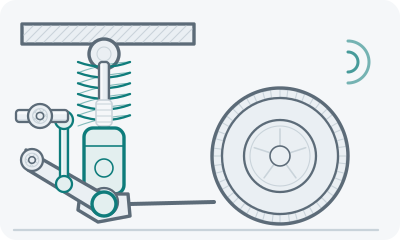
A knock in the rear suspension takes longer to find on average than one at the front — and not because there are more parts back there. On the contrary, there are fewer, but the sound travels through the body, the driver sits a long way from the source, and half of all “knocks at the rear” have nothing to do with the suspension at all. Here is where to start, which parts knock most often, how a torsion beam differs from a multi-link, and what decides the repair.
Rule out the simple things first
Before booking a diagnosis it is worth spending ten minutes:
- empty the boot and the spare wheel well — a jack, spanners, bottles and an untightened spare rattle over potholes indistinguishably from the suspension;
- check the parcel shelf and the trim — plastic on older cars rattles on washboard surfaces;
- look under the car — an exhaust on stretched rubber hangers knocks against the body over bumps, with a hollow metallic sound;
- recall any recent work — if the knock appeared after a tyre change, check the wheel bolt torque first.
If the knock survives all that, the source really is in the running gear.
Common causes of a knock at the rear
| Part | How it sounds | Additional signs |
|---|---|---|
| Dampers and their bushes | Dull knock on medium and large bumps | Body float, oil weeping from the body |
| Rear anti-roll bar links and bushes | Frequent chatter on small stuff | Not fitted to all cars; quietens in bends |
| Beam or arm bushes | Dull single knock on expansion joints | The rear wanders, tyre wear at the edges |
| Sagged or broken springs | Knock, grinding, especially under load | Rear sitting low, leaning to one side |
| Bump stops and bottoming out | Hard impact when fully loaded | Knock only with passengers or a load |
| Exhaust mountings | Hollow metallic clatter | Also heard when the parked car is rocked |
Most often it is the dampers and their mountings that knock at the rear: the lower mounting bushes get hammered out, and a damper with play in the rod knocks dully and irregularly. The full list of signs — from body float to patchy tyre wear — is in signs of worn shock absorbers and how to tell shock absorbers are dead.
Torsion beam or multi-link: why it matters
The type of rear suspension determines the list of suspects. On cars with a semi-independent torsion beam (most budget saloons and hatchbacks) there is almost nothing to it: two bushes mounting the beam, springs, dampers and bump stops. A knock is found quickly there, and the commonest finding is worn beam bushes: a dull knock on expansion joints and potholes plus a feeling that the rear steers itself in ruts.
A multi-link suspension (crossovers, cars a class above) is more complex: four or five arms per side, each with its own bushes, plus often a rear anti-roll bar with links. It takes longer to wear out, but the diagnosis requires working through the joints more carefully. The character of the knock is the same as at the front: small amounts of play knock on small bumps — that logic is covered in detail in front suspension knock over small bumps.
There is a factor common to both layouts — overloading. The rear suspension is designed for the rated load, and regular trips with a full boot, a trailer or five passengers over broken roads cut the life of the springs, bump stops and bushes severalfold. If the car is often driven loaded, a knock at the rear is worth looking for among those parts first, as in a knock only with passengers or a load.
How to check it yourself
- The load test. Drive a rough stretch you know empty, then with passengers in the back. The knock grew under load — look at the springs, bump stops and dampers; unchanged — the joints and the anti-roll bar are more likely.
- Bouncing. Rock the car energetically by a rear corner. Creaks and knocks while bouncing on the spot are a reason to inspect the damper and its bushes; at the same time judge how quickly the oscillation dies away — checking shock absorbers with the bounce test.
- A look underneath. A torch and five minutes: oil weeping from the dampers, intact boots, the state of the springs (the lower coils break most often), the rubber of the exhaust mountings — signs of worn suspension springs.
- A helper. One rocks the rear while the other listens at the wheel and in the boot. The step-by-step home method is in finding a suspension knock without a lift.
Neighbouring sounds and their causes are on the symptom pages knocking in the suspension and knocking over bumps — worth comparing against your own picture before the workshop visit.
How the repair is decided
Two findings decide the work. If the play is in the bushes, they are pressed out and replaced and nothing else is touched — that is usually the cheapest repair in the running gear. If a damper is weeping or has play in the rod, the job grows: dampers go in pairs across the axle, and the bump stops and boots are replaced at the same time, since they are only reachable with everything apart.
Three things mechanics do not always say. On a multi-link, replacing arms or the beam may call for a rear alignment — clarify that before the work starts so the bill is not a surprise. Fasteners seize more often at the rear than at the front, being closer to the dirt thrown by the wheels and to road salt; a higher-than-average quote justified by seized beam or arm bolts is usually real labour, not padding. And the beam mounting bolts are finally torqued with the suspension loaded — done up with the beam hanging, the bush rubber lives twisted and knocks again within months.
If a knock at the rear still cannot be pinned to a specific part, record it in the Pro-Stuk app: it matches the sound with your answers about when and on what kind of bumps it appears and shows the likely causes with a level of urgency — with that list the diagnosis on a lift goes faster.
