

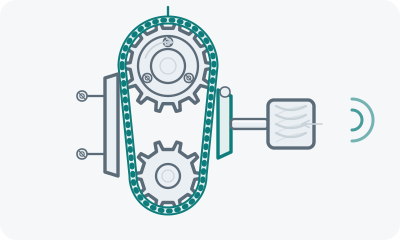
A short metallic rattle in the first seconds after a cold start is the best-known complaint from owners of early chain-driven 1.4 TSI turbo engines. The sound lasts a second or two, then the engine runs smoothly, and it is exactly that brevity which lulls you: it seems to have grumbled and stopped. In reality this is a conversation not about noise but about the reserve left in the drive. Here is where the rattle comes from, how to tell it from other knocks and what the fix involves.
Why it rattles at start-up specifically
The timing chain is tensioned by a hydraulic tensioner that works off oil pressure. While the engine stands the oil drains, the pressure in the system falls, and the tensioner loses part of its push. At the moment of starting the chain is briefly left slack: it slaps against the guides and dampers, and you hear the characteristic chatter. A couple of seconds later the pressure is restored, the chain is tensioned, the sound goes.
While the chain is new the effect is barely noticeable. With mileage the chain’s pins and rollers wear, its effective length grows, and the tensioner extends further and further to compensate for the slack. When the tensioner’s travel is nearly used up there is nothing left to compensate with — the rattle at start-up gets longer and appears more often, including on a warm engine on a sharp lift-off.
Oil is a separate factor. Thickened, worn-out oil or oil of the wrong viscosity takes longer to build pressure, and the “weak tensioner” stage is stretched out. That is not a cause of wear, but it is a noticeable accelerator.
Telling the chain from other knocks
| Sound | When it is heard | Likely source |
|---|---|---|
| Chattering rattle 1–2 sec after start-up | Only when cold | Chain and tensioner |
| Even ticking, rises with revs | Constantly | Hydraulic lifters, valves |
| Bright knock under load | On acceleration | Detonation, fuel, plugs |
| Hum and whine, unrelated to starting | At revs | Accessories, idlers, water pump |
| Knock from below when pulling away | Over bumps | Engine mounts, exhaust |
The main separator is the link to a cold start. The signs by which a chain is identified at every stage, from the first rattle to cam timing fault codes, are collected in signs of a stretched timing chain, and the tensioner’s own symptom list in timing chain tensioner failure signs. If the sound is constant and independent of warm-up, start instead with an engine knock only when cold, and the full catalogue of cold sounds is on the symptom page engine knock when cold.
What a workshop checks
Diagnosis runs from simple to complex. First they listen to the engine at start-up and on lift-off, then read the codes from the camshaft and crankshaft position sensors: a cam timing offset is direct evidence for a stretched chain. Next the top cover comes off and the position of the tensioner plunger and the state of the guides are assessed: a plunger extended a long way and pressed-through plastic guides are visible at once. How the same check is done by ear is in checking timing chain tension by ear.
Importantly, the answer is almost never “tighten it”. The tensioner is not manually adjustable, and wear of the guides and chain is irreversible. So the outcome is one of two: either the chain is still within limits and you watch it, or the drive is replaced as a kit.
How the repair is decided
The criterion is the measurement, not the sound: the cam timing offset read with a scan tool and the extension of the tensioner plunger. While both are within limits, the sensible course is to watch — record the start-up and compare it a month later. Once the offset is outside tolerance or the plunger is near the end of its travel, the drive is replaced as a kit.
Two things worth knowing before agreeing to the work. First, the strip-down is the bulk of the labour, so saving money by replacing only the tensioner means paying almost the same labour again when the chain finally goes — ask what the chain measured before choosing. Second, the guides and dampers are plastic and are what the chain actually beats against; a kit without them is not a repair. Ask to see the old parts: pressed-through guides tell the story of the oil regime more honestly than any estimate.
Oil deserves a separate mention. Regular changes at the recommended viscosity do not make a chain eternal, but they noticeably slow the wear of its joints and shorten that second of weak tension at start-up. The habit of topping up rather than changing costs the most here: how the drive works depends directly on how fast the system builds pressure.
If the rattle at start-up has appeared recently and you want to know whether it is that sound, record it in the Pro-Stuk app straight after a cold start, before warm-up. The app matches the recording with your answers and shows the likely causes with percentages — enough to arrive at a workshop with a specific theory rather than general anxiety.
