

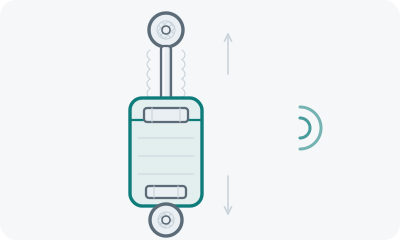
Camrys of different generations share one complaint: on small bumps, expansion joints and washboard surfaces a dry single knock appears at the front, while on large potholes the suspension works normally. Owners usually phrase it as “the dampers are knocking” — and half the time they are wrong. A car with a comfortable, soft suspension shows wear in the small parts around the strut particularly clearly, rather than in the strut itself. Here is what actually knocks and the order in which it is checked.
What knocks around the damper
A front strut is not one part but an assembly: the damper, the spring, the top mount with its bearing, the bump stop and the boot. Next to it work the anti-roll bar links and the control arm bushes. The knock can be born in any of those places, and the sound will be very similar.
- Anti-roll bar links. The most common cause of a dry rattling knock over small undulations. A cheap part, quickly replaced — signs of worn anti-roll bar links.
- The top mount and its bearing. They give a dull knock over bumps and a characteristic click or crunch when steering while parked — a noisy strut top mount bearing.
- The bump stop. A disintegrated bump stop turns every suspension movement into metal-on-metal impact: signs of worn bump stops.
- The damper itself. It knocks when it has lost some oil or is broken internally; then body float after a pothole joins in.
- Control arm bushes. A duller, rubbery knock, often with vague steering.
The sound portrait of that whole group is on the symptom page knocking over bumps.
Checking it yourself
| Check | How | What it points at |
|---|---|---|
| Bounce | Push the wing down and release | More than one oscillation — the damper |
| Steering while parked | Turn lock to lock in a car park | Click or crunch — the top mount bearing |
| Strut inspection | Look at the damper body | Oil weeping — the strut needs replacing |
| Anti-roll bar | Rock the wheel and listen | Rattle — the links |
| Speed hump | Cross it slowly | Knock going on and off — mount or bump stop |
These checks do not replace a lift, but they are free and in ten minutes they eliminate the cheapest theories. If suspicion still falls on the dampers, the next step is an inspection from below with a pry bar; the full set of signs is in signs of worn shock absorbers.
Why it is considered a typical problem
It is not a design defect but a combination of factors. The Camry has a softly tuned suspension and a decent mass, it is often used as a taxi and fully loaded, and roads pick up cracks and settlements over a winter. In those conditions the small rubber-to-metal components give up first: anti-roll bar links, mounts, bump stops. Dampers last longer with careful driving, but past a hundred thousand kilometres they lose their characteristics imperceptibly — the car starts floating on undulations, and the owner adapts without noticing.
How the repair is decided
The budget logic is simple: replace what costs a little first and only then what costs a lot. If the knock disappears after new anti-roll bar links, the question is closed.
Two things worth knowing before the strut comes apart. If it does come apart, the top mount bearing, the bump stop and the boot are all reachable for the price of the parts alone, and doing them later means paying the same labour again. And the alignment afterwards is not optional.
Ask for the hubs to be checked on the same lift: a hum and a knock often arrive together, and the signs of that part’s wear are in signs of a worn wheel bearing.
If the knock is still occasional and cannot be reproduced for the mechanic, record it with the Pro-Stuk app while driving over a familiar bump. The app matches the recording with your answers and shows the likely causes with percentages — at the very least it becomes clear where to start looking.
