

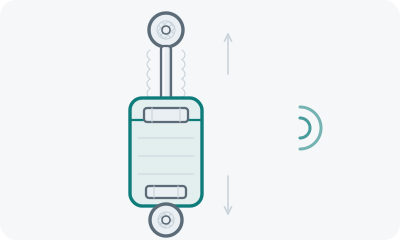
A simple, easily serviced car makes a convenient example for this breakdown: the front suspension layout is straightforward and the set of possible knock sources is limited. The typical complaint sounds like this — on small bumps, concrete slab joints and washboard surfaces there is a dry knock at the front, while on large potholes the suspension works softly and silently. Here is what lies behind that picture and the order in which everything is checked.
Why the knock comes on small bumps
A damper controls oscillation by forcing oil through valves. On a long smooth stroke it copes; on a short sharp one the load falls on the most worn places — the mounting bushes, the fixings, the top mount, the bump stop. If a clearance of a fraction of a millimetre has appeared somewhere, you will not hear it on a big pothole, because the suspension moves smoothly and continuously. On a small bump the movement is abrupt, the clearance is taken up instantly — and you get a metallic click.
Hence a practical conclusion: a dry knock on small stuff almost always means play, not a “dead” damper. A dead damper shows itself differently — body float, the car swimming over undulations, a longer stopping distance, as described in signs of worn shock absorbers and how to tell shock absorbers are dead. The general breakdown of this group of sounds is on the symptom page knocking in the suspension.
What is checked, in order
| Step | What is looked at | Sign of a fault |
|---|---|---|
| 1 | Anti-roll bar links | Rattle when the wheel is rocked |
| 2 | Strut top mount | Click when steering while parked |
| 3 | Bump stop and boot | Crumbling, destroyed, eaten away |
| 4 | Damper body | Oil weeping, damp dust |
| 5 | Strut fasteners | Loose nuts, hammered-out bushes |
| 6 | Control arm bushes | Dull knock, rubber delaminating |
The order is not accidental: it runs from the cheapest and most common to the most expensive and rarest. Replacing a strut without checking the anti-roll bar links and the top mount is the usual, galling mistake after which the knock stays exactly where it was — checking anti-roll bar links for knocking and strut top mount bearing noise symptoms cover those two first steps.
How to check it yourself in ten minutes
Put the car on level ground. Press down on the front wing with all your weight and release sharply: the body should come back and stop, with one settling movement at most — the method in full is in checking shock absorbers with the bounce test. Then turn the wheel to full lock both ways, listening around the strut — a click or crunch gives away the top mount bearing. Rock the wheel by hand up and down and side to side: a knock here most often means an anti-roll bar link or a ball joint. Finally, drive slowly over a speed hump with the window slightly open: a knock going on and coming off is also a signal in favour of the top mount and the bump stop — signs of worn bump stops.
If none of that finds anything and the knock is still there, it is worth confirming that the source is in the suspension at all: similar dry sounds at low speed sometimes come from the engine bay, and the trick for separating them is a blip of the throttle with the car standing — the engine answers, the suspension stays silent.
How the repair is decided
The criterion is what the check actually found, not what is easiest to sell. Play in a link or a top mount is a replacement of that part. Oil weeping from a damper body means the damper, and then in pairs across the axle. A crumbled bump stop and a torn boot are cheap parts, but they are replaced together with the strut being apart — going back in for them separately means paying for the same labour twice.
Three things mechanics do not always say. New struts need their fasteners finally torqued with the car’s weight on the wheels, not with the suspension hanging — otherwise the rubber bushes live twisted and knock again within months. Bump stops and boots are consumables and are often left out of the quote, yet they are what protects a new damper. And an alignment after any strut work is compulsory, since removing a strut changes the camber on most designs.
Where the design is simple and the parts common, there is a case for doing the whole front end at once rather than driving with a slowly growing list: the labour overlaps almost completely, and a second visit costs nearly as much as the first.
To avoid guessing what exactly is knocking, record the sound in the Pro-Stuk app while driving over a rough stretch you know. The app compares the recording with your answers to a few questions and shows the likely causes with percentages — with that list it is easier to agree with a mechanic on what to look at first.
