

A chattering knock from somewhere around your feet that appears on small bumps and is especially clear at low speed is one of the most common worries for Kia Rio owners. In most cases the source really is the steering, but not always the rack — and when it is the rack, it does not always need replacing. Here is where the sound comes from, how to confirm the address and what workshops actually choose.
Where a rack knock comes from
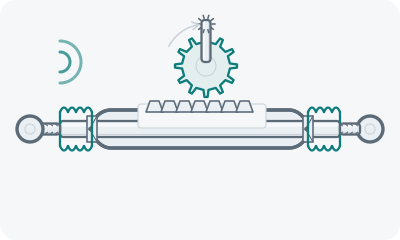
A steering rack is a rack and pinion: a gear on the steering shaft and a toothed bar that moves across the car. A spring-loaded yoke with an adjuster nut presses the bar against the gear. A car spends most of its life going almost straight, so the teeth wear unevenly — most of all in the central zone around the straight-ahead. When the wear exceeds the yoke’s compensating travel, a clearance appears between the teeth. Every impact from the road passes through the wheels, the rods and the bar, the clearance works — and a dry click arrives in the cabin.
On compact cars the effect is more audible because of the short firm suspension and small cabin: the sound barely has room to dissipate. Broken roads, washboard surfaces and the habit of crossing speed humps at an angle all add to it.
Rack or not the rack
Before dismantling any steering, rule out the neighbours — they knock similarly and cost several times less.
| Source | Character of the sound | How it is checked |
|---|---|---|
| Rack and pinion | Dry click from the centre, on fine shaking | A hand on the rack housing while the wheel is rocked |
| Anti-roll bar links | Rattle over bumps, ignores the steering | Rocking the raised suspension |
| Track rod ends | Knock when the wheel is rocked while parked | Play check on a lift |
| Strut top mount bearings | Crunch and clicks when steering while parked | A hand on the spring while the wheel turns |
| Rack mounting bushes | Dull thump, the sound wanders | Checking the clamp fasteners |
A simple home test: with the car parked and the engine off, jerk the wheel a couple of centimetres left and right a few times while keeping a hand on the rack housing under the dashboard. A knock synchronous with your movements points the suspicion at the steering. If the sound only arrives on the move over bumps and the steering has nothing to do with it, start with the dampers and the anti-roll bar links — their full picture is in signs of worn shock absorbers, and the general catalogue of similar sounds is on the symptom page knocking in the suspension. Worn steering ends have their own portrait in signs of worn track rod ends.
Adjust or rebuild
An adjustment means turning the yoke’s adjuster nut to remove the clearance in the rack and pinion. The procedure is quick and cheap, and with moderate wear it honestly solves the problem. There are two limits. First, the adjustment only works while the yoke has travel left — on a badly worn rack there is nowhere left to turn. Second, an over-adjusted rack becomes heavy, the wheel stops self-centring, and that is noticeably worse than a knock.
A rebuild with dismantling means new bushes, seals, the yoke itself, and regrinding or replacing the bar. It is chosen when the knock is joined by fluid stains on the bellows, heavy or binding steering, or unequal effort in different positions. Replacing the complete rack is the last resort, usually with heavy wear or a damaged housing — the full symptom list is in signs of a faulty steering rack.
Urgency and what to ask
You can drive with a rack knock for weeks, and there is no need to panic. But postponing the diagnosis is only reasonable while the sound is even and unchanging. Play in the wheel, fluid stains, a change in effort or foreign grinding when turning mean going to a workshop within days.
Two things worth asking there. Whether the adjustment has any travel left before it is done — an adjuster already at its limit means the answer is a rebuild, not a tweak. And whether an alignment follows: any work involving the tie rods changes the toe.
If you are unsure what is knocking — the rack, the links or the ends — record the sound in the Pro-Stuk app while driving over a fine bump and repeat the recording while rocking the wheel with the car parked. The app matches the recordings with your answers and shows the likely causes with percentages, so you arrive at the workshop with a hypothesis.
