

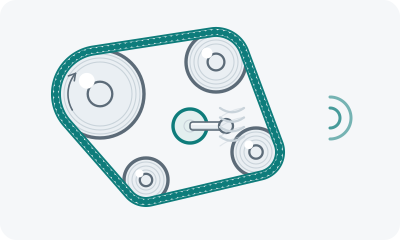
An alternator decoupler pulley is a pulley with a built-in one-way mechanism, working like a bicycle freewheel: the belt can drive the alternator rotor but cannot slow it down. It is an inconspicuous part, and many owners first hear of it at a workshop — yet its wear is behind a good half of the “whistles at startup” and “rattles under the bonnet” on cars of the past twenty years.
Why an alternator needs one
The crankshaft turns unevenly: each power stroke pushes it on, each compression stroke holds it back. The belt passes those micro-pulses to every accessory. Most of them tolerate it, but the alternator has a heavy rotor spun to high speed which, by inertia, does not want to slow down thousands of times a minute.
Without a decoupler the belt has to jerk the rotor back and forth: hence vibration, squealing and accelerated wear of the whole drive. The decoupler breaks that link — at every micro-deceleration of the crankshaft the rotor freewheels past the belt and the pulse is absorbed. It matters most on diesels and on engines with stop-start, where the unevenness is greater.
Signs of failure
A decoupler fails in two ways: either it stops gripping and slips, or it seizes and becomes a rigid pulley. Both scenarios have recognisable symptoms:
- a whistle at the moment the engine starts and stops — a worn decoupler slips exactly at those sharp changes of speed; the general breakdown of that sound is on the symptom page squeal on startup;
- rattling or chattering for a few seconds after switching off — the spinning rotor carries on by inertia and a dying decoupler chatters like a bicycle freewheel;
- visible belt vibration at idle — the belt flaps between the pulleys because the pulses are no longer absorbed; against the general background that shows as engine shake too, see vibration at idle;
- undercharging — a fully slipping decoupler stops turning the rotor under load: the charge light can come on at idle;
- hum and rustle from the alternator pulley — the decoupler’s own bearings are worn.
How to check it yourself
The check takes five minutes and does not need the alternator off. With the engine stopped, remove the pulley’s decorative cap (if fitted) and hold the rotor shaft with a hex key through the central hole. Now turn the pulley by hand:
- one way it should turn freely with a light rustle — that is the freewheel;
- the other way it should drive the shaft firmly — the working direction.
The verdicts: the pulley turns freely both ways — the decoupler is slipping and not transmitting drive; it is rigid both ways — it has seized and is working as a plain pulley. Either way the part needs replacing. Also look for grease and rubber dust around the pulley and a chewed belt edge.
What it gets confused with
| Sign | Decoupler pulley | Alternator bearing | Belt |
|---|---|---|---|
| Whistle at start-up and shutdown | Characteristic | Rarely | Possible |
| Rattle after the engine stops | Characteristic | No | No |
| A whine that grows with revs | No | Characteristic | No |
| Reaction to switching the lights on | Weak | The whine grows | The squeal grows |
| Belt vibration at idle | Characteristic | No | With weak tension |
The bearing’s own signs are in signs of a worn alternator bearing, idler pulleys in signs of a worn idler pulley, and what a snapped belt costs in can you drive with a squealing belt. The same “noise only in the first seconds after starting” pattern also occurs in the timing drive — its own mechanics are covered in signs of a failing timing chain tensioner.
How the replacement is decided
A decoupler is not serviceable or greaseable — it is replaced. Removing it needs a special multi-spline tool, so the work is usually combined with a belt change or an alternator overhaul: the disassembly is shared and both time and money are saved.
Two things worth asking. Whether the belt is being replaced at the same time — a belt that has run on a seizing decoupler has taken the pulses the decoupler was supposed to absorb, and often shows it in cracked ribs. And whether the tensioner was checked against its wear indicator: a slipping decoupler and a tired tensioner produce very similar belt noise, and replacing one while ignoring the other leaves the sound in place.
Typical decoupler life is around 100,000 km, so its condition is always worth checking at a scheduled belt change.
Not sure whether it is the decoupler, a bearing or the belt? Record the sound at startup and shutdown in the Pro-Stuk app — it matches the recording with typical fault sounds and shows the likely causes with an urgency level.
