

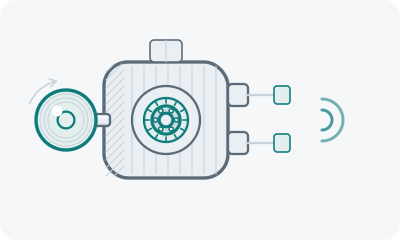
The alternator is the fastest-turning unit on the accessory drive: its pulley is two to three times smaller than the crankshaft pulley, so the rotor spins to tens of thousands of revolutions per minute. It runs on two rolling bearings, and when they wear the alternator becomes the main source of foreign noises under the bonnet. The good news: those noises have a recognisable signature, and the suspicion can be tested without dismantling anything.
Why alternator bearings wear
There are several causes of accelerated wear, and almost all of them are external. Belt tension presses on the rotor shaft with a constant side load — if the belt is over-tightened, the load on the front bearing multiplies. From below the alternator catches water and dirt from the road: deep puddles and pressure-washing the engine wash the grease out. From above the exhaust manifold heats it — heat thins and ages the grease faster.
Add the belt jerks from the crankshaft’s uneven rotation, which the decoupler pulley is supposed to absorb; a worn decoupler does the opposite and passes the shocks straight into the shaft. So the condition of the decoupler and the bearings is directly linked.
What the wear sounds like
The sound develops in stages, and it can be caught at each of them:
- A thin whistle when cold. The first minutes after starting, fading as it warms — the grease has thickened and is not covering the raceways. A slipping belt gives a similar sound; the difference is on the symptom page belt squeal.
- A whine that rises with revs. The most recognisable stage: a tonal sound that climbs when you blip the throttle and grows noticeably with the headlights and heated screen on — electrical load presses the rotor harder.
- Hum and rumble at any revs. The raceways are broken; the sound is there at idle and on the move, and does not follow road speed.
- Grinding and a metallic rustle. The cage is disintegrating — seizure is a few journeys away.
The key marker at every stage: the sound follows engine revs rather than road speed, and does not change in turns — unlike a wheel bearing. A model-specific example is in Chevrolet Cruze: alternator bearing whine.
How to check without dismantling
Four techniques available in a garage:
- The load test. At idle, switch on the main beam, the heated rear screen and the blower. A whine that grows is strong evidence for the alternator.
- A stethoscope. The tip on the alternator casing with the engine running — a worn bearing is heard immediately. A long screwdriver with the handle to your ear works too; keep clear of rotating parts. The home-made versions are described in a mechanic’s stethoscope you can make yourself.
- Running without the belt. A brief start with the accessory belt removed: if the sound disappears, an accessory is to blame; if it remains, look deeper into the engine.
- Checking for play. With the engine off, rock the alternator pulley across its axis by hand: a perceptible knock or play means the bearings are broken.
What it gets confused with
| Sign | Alternator bearing | Decoupler pulley | Belt idler | Water pump |
|---|---|---|---|---|
| Reaction to lights and heaters | Grows | None | None | None |
| Whistle on start-up and shutdown | Rarely | Characteristic | Possible | Possible |
| Rattle after switching off | No | Characteristic | No | No |
| Coolant weeping | No | No | No | Characteristic |
An even whine from an idler is covered in signs of a worn idler pulley, a hum with coolant traces is a reason to check the pump — a whining water pump: how to check it — and the general fork between the two units is in whine under the bonnet: alternator or water pump.
How the repair is decided
Alternator bearings are a consumable, and replacing them is better value than replacing the whole unit; a new alternator costs several times a rebuild, so overhauling is standard practice.
The questions worth asking before agreeing to the job are these. What else comes out of it — brushes, the regulator, the decoupler — since the alternator is already off and the labour is paid for. Whether the belt tension was checked, because an over-tightened belt is what killed the old bearings and will kill the new ones. And whether the alternator’s own cooling path is clear: a unit clogged with dirt runs hotter and cooks its grease.
There is one reason not to drag it out: a seized bearing stops the whole belt drive. The car instantly loses charging, and on many engines the water pump and the power steering too. What was a booked repair becomes a tow truck.
If a whine or hum has appeared under the bonnet and you want to identify the source before the workshop, record the sound in the Pro-Stuk app — it matches the recording with typical fault sounds and shows the likely causes with an urgency rating.
