

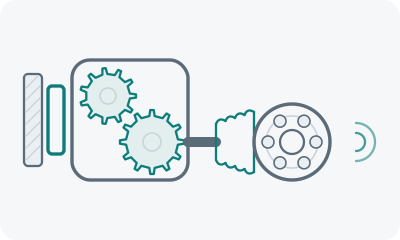
One of the most useful self-diagnosis techniques looks almost indecently simple: accelerate to the speed at which the stray sound is audible and select neutral. How the sound then behaves splits all possible sources into two large groups — and that saves both time and money on diagnosis. Here is exactly what the test shows, how to do it properly and how to read the result.
What happens in neutral
In neutral the connection between the engine and the wheels is broken. The engine keeps running at idle, the wheels keep rolling, but torque is no longer transmitted through the gearbox. So everything that makes noise because of the drive being transmitted — gears under load, the clutch, the driveshafts, the power unit mounts — either falls silent or noticeably changes its voice.
And whatever rotates simply because the car is moving keeps making the same noise: wheel bearings, tyres, warped brake discs, a shield touching a disc. Their rotational speed depends only on road speed, and changing gear means nothing to them.
How to run the test properly
- Choose the place. A level road with no gradient, no cars nearby, 50–80 km/h — the speed at which the sound is confidently audible.
- Select neutral without switching the engine off. On an automatic that is N; on a manual, press the clutch and take the lever out of gear. Hold neutral for a few seconds, listening.
- Select the gear again. On an automatic at a speed appropriate to the mode, without a jolt; on a manual with the usual blip.
- Repeat two or three times. One run tells you little: what matters is that the change in the sound repeats consistently.
An extra step is to compare coasting under light throttle and without it in the same gear. If the noise grows specifically under load, that is a strong separate sign.
How to read the result
| Behaviour of the sound | Likely group of causes |
|---|---|
| No change at all | Wheel bearing, tyres, brake mechanism |
| Quieter or gone | Gearbox, driveshafts, clutch, mounts |
| Gone along with the vibration | Engine and gearbox mounts, propshaft imbalance |
| Only the pitch changed | Body or exhaust resonance at certain revs |
| A new sound appeared in neutral | Release bearing, gearbox noise at idle |
The last row often surprises: on a manual, a noise heard specifically in neutral with the clutch up usually belongs to the input shaft and gearbox bearings rather than the running gear — the separation test is in a noisy release bearing: can you drive?.
What to do with the result
The test does not make a diagnosis, it narrows the field. The logic from there is simple: if the sound did not change, the next check is raising the wheels and listening to the hubs; if it did, an inspection of the mounts and driveshafts on a lift under load. Bear false positives in mind too: in neutral some of the wind and road noise disappears simply because you are coasting and usually slowing slightly. So the result counts as reliable only if it repeats several times.
The difference in cost between “a wheel bearing” and “the gearbox” is tenfold, which is why five minutes on the test pays for itself. The individual portraits are in signs of a worn wheel bearing, signs of worn engine mounts and gearbox whine at a particular speed.
Two things worth telling the mechanic afterwards. Whether the sound followed the road speed or the engine revs, and whether it survived neutral — those two sentences save an hour of searching and are the whole point of doing the test at home. And if the answer was “unchanged in neutral”, say so explicitly: it is what keeps an expensive gearbox investigation off the work order.
If the knock or hum is indistinct and the difference is arguable by ear, the technique from a knock you only hear with the window open helps, and the full set of road noises is covered on the symptom page humming while driving.
Recording both runs — in gear and in neutral — is convenient in the Pro-Stuk app: it compares the clips, matches them with your answers about speed and conditions and shows the likely causes with percentages. You arrive at the workshop with a theory rather than a vague “something hums”.
