

The Hyundai Solaris and its close relatives are among the most common cars on the road, and a knock that reaches the wheel over small bumps is on the short list of typical owner complaints. Everyone describes the sound the same way: a dry click or chatter somewhere deep in the front of the car, felt through your palms on the wheel. The steering rack really is a frequent culprit — but far from the only one, and blaming it first is a reliable way to overpay.
Where a rack knock comes from
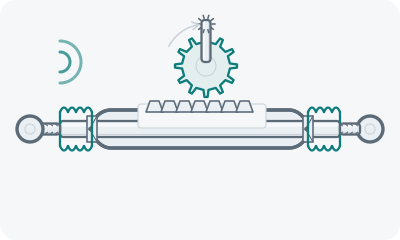
A rack and pinion mechanism is simple: a toothed bar runs inside a housing, the pinion on the steering shaft moves it, and a spring-loaded pressure bush keeps the teeth engaged without clearance. With mileage the bush and the supports wear, the clearance grows, and on every bump the bar takes an impact from the wheels which passes into the housing and on into the wheel.
The conditions are characteristic: small frequent bumps, low speed, the knock felt through your hands. On smooth tarmac and in fast bends the rack is usually silent. What makes the wear worse is broken roads, driving with the wheel held at full lock, and the age of the unit — the part is a consumable by nature.
What a rack knock is confused with
| Source | How it shows itself |
|---|---|
| Anti-roll bar links | Chattering knock at the front on small bumps, barely reaches the wheel |
| Track rod ends | Knock when the wheel is rocked while parked, play on a lift |
| Strut top mount bearing | Crunch and clicks when steering, not when driving over bumps |
| Ball joint | Dull single knock, more often on large bumps |
| Steering rack | Dry chatter through the wheel, tied to small bumps |
A simple technique helps to separate them: ask a helper to rock the wheel left and right through a small angle with the car parked and the engine off, while you keep a hand on the tie rod and the rack housing. A knock felt in the housing points at the rack; a knock in the joint points at the end — the method is set out in a knock: steering rack or track rod ends.
It is also worth ruling out sounds not connected with the steering at all. A hum tied to speed is the running gear, covered in signs of a worn wheel bearing. A sound audible with the car standing and the engine running is a different subject entirely. The general catalogue of running gear noises is on the symptom page knocking in the suspension.
Adjustment or repair
At an early stage, when the wear is small, the knock is removed by an adjustment: the adjuster nut takes up the clearance in the pressure bush. The procedure is quick, but it demands care — an over-tightened rack makes the steering stiff and slow to return to centre, which is worse than the original knock. The criteria for choosing are set out in a steering rack knock: adjust or replace, and the same question on a close relative in Kia Rio steering rack knock.
When the adjustment stops helping, or helps for a couple of weeks, it is a repair: new bushes and supports, and with heavy wear or leaks a full rebuild. A rack with worn teeth and a damaged housing is not restored, it is replaced. The complete symptom list is in signs of a faulty steering rack.
Simple things extend the life of the mechanism: do not hold the wheel at full lock for more than a few seconds, keep the rod boots intact, and do not ignore worn anti-roll bar links — the impacts from them arrive at the steering gear too. Replacing split bellows in good time matters separately: water and dust that get inside kill a rack faster than mileage does.
How the repair is decided
The order follows from the table above: first rule out the anti-roll bar links and the track rod ends, then discuss a rack rebuild. Those parts wear faster, are checked in minutes, and in a fair share of cases the knock ends with them — signs of worn anti-roll bar links and signs of worn track rod ends.
Two things mechanics do not always mention. An adjustment has a finite range, and if the adjuster is already near its limit the next attempt buys weeks, not months — worth asking about before the work rather than after. And any intervention in the steering ends with an alignment: skip it and the front tyres wear at the edges within a few thousand kilometres.
If the knock does not appear every time and the workshop cannot reproduce it, record the sound in the Pro-Stuk app while driving over fine bumps. The app compares the recording with your answers and shows the likely causes with percentages — which saves you from a conversation in the “well, it sort of knocks” genre.
