

A rattle at start-up is a frequent cause for alarm and at the same time one of the most readable sounds: the source can nearly always be narrowed to two or three parts before the workshop visit. The key to the diagnosis is the moment the sound appears: while the starter is turning the engine, in the first one to three seconds after it fires, or throughout its running. Here are the causes sorted by that sign, plus simple checks that need no tools.
The first observation: when exactly it rattles
A rattle at start-up has three typical scenarios, and each points at its own group of parts.
- A rattle while the starter is cranking, before the engine catches — almost always the starter and its engagement with the flywheel.
- A rattle in the first one to three seconds after it fires, then silence — the engine’s hydraulics, left without oil pressure while the car stood: cam phasers, the chain tensioner, the hydraulic lifters.
- A rattle that does not go at all — the accessories: the alternator decoupler pulley, the idlers, less often the exhaust heat shields.
It is worth starting the engine two or three times — cold and warm — and noting which of the three phases the sound lives in. That narrows the search more than any guesswork about timbre.
A rattle while the starter cranks
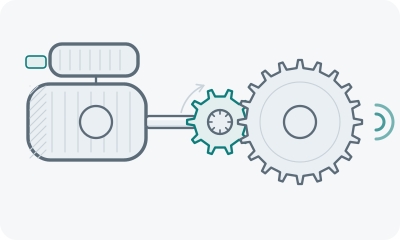
Between the starter and the engine sits the drive pinion on a one-way clutch, which engages the flywheel ring gear for the duration of the start and should disengage once the engine fires. Wear in that pair gives a characteristic metallic rattle: the pinion skips over the teeth without transmitting effort, or bangs against the ring gear without engaging.
The ring gear can be at fault too: its teeth wear unevenly, because the engine stops in the same positions time after time. Then the rattle appears on alternate starts — when the pinion lands on a chewed section.
If the sound is closer to metal grinding on metal, see the breakdown in a grinding noise when starting the engine. And if you hear a machine-gun chatter with the crankshaft not turning at all, the cause is almost certainly the electrical supply — that is covered in the starter chatters but will not crank and the starter clicks but will not crank.
A rattle in the first seconds after it fires
Overnight the oil drains from the top of the engine into the sump, and for the first moments after starting the hydraulic components work without pressure behind them.
- Cam phasers — the couplings on the camshafts that rotate the shaft to change the valve timing. A worn coupling without oil pressure is not locked and rattles — a dry, diesel-like sound from the top of the engine, described in cam phaser rattle when cold.
- The hydraulic chain tensioner does not take up the slack immediately — the chain rustles and taps against the guide for a second or two: signs of a stretched timing chain.
- Hydraulic lifters tick more quietly and evenly, but for longer: hydraulic lifters ticking when cold.
All three scenarios share one thing: the sound goes as soon as the oil pressure rises. More about this group of sounds is on the symptom page engine knock when cold and in a knock that goes away with warm-up. The more worn the parts and the older the oil, the longer the rattle lasts: if it fades not in seconds but over minutes of warm-up, that is already a settled sign of wear rather than a feature of cold starting.
A rattle that does not go: the accessories
A constant rattle on a running engine is rarely connected with the engine itself. The typical sources:
- the alternator decoupler pulley — the unit inside the pulley that smooths jerks in the belt; when worn it rattles and clatters at idle and on throttle blips, alternator decoupler pulley failure signs;
- idlers and the belt tensioner with worn bearings — rustling often joins the rattle, signs of a worn idler pulley;
- an exhaust manifold heat shield with a loose fastener — it rattles at certain engine speeds and quietens as they change.
It is important not to confuse a rattle with a squeal: a thin yelp at start-up is a slipping belt, which has its own search logic described on the page squeal on startup.
| Moment it appears | Likely source | What to do |
|---|---|---|
| While the starter cranks | Starter pinion, flywheel ring gear | Diagnose without delay |
| 1–3 seconds after firing | Cam phasers, chain tensioner | Check the oil, watch it |
| First minutes, goes with warm-up | Hydraulic lifters, timing chain | Scheduled diagnosis |
| Constantly | Decoupler pulley, idlers, heat shield | Diagnosis this week |
How the repair is decided
The order follows the table, and the criterion is which phase the sound lives in. For the hydraulic group, start with oil and filter to the correct specification — that alone closes a large share of cases, and it costs less than any part. For the starter group, do not wait: a chewed ring gear turns the replacement of an inexpensive pinion into a flywheel replacement with the gearbox out, which is a different order of labour entirely.
Two things mechanics do not always say. If the starter is repaired, ask for the flywheel ring gear to be inspected through the inspection hole while the starter is off — that is the one check that decides whether you are back in six months. And if the chain drive is replaced, the guides and dampers go with the chain: they are the plastic parts the chain actually beats against.
If you cannot pin the rattle to a moment of the start by ear, record the sound in the Pro-Stuk app: it matches the recording with your answers about when and how the sound appears and shows the likely causes with percentages and a level of urgency — an easier list to arrive at a workshop with.
